Wednesday, April 26, 2006

Books (Science): Struck By Lightning

I haven't posted much about books lately, except for the bit on Tezuka's Buddha. Recently my reading has been rather scattered -- until yesterday I had four books on the go, jumping between them, not really able to stay focused on any one for long.

But yesterday I finished the most recent of the four, Struck by Lightning: The Curious World of Probabilities by Jeffrey Rosenthal, a University of Toronto professor of statistics. It's a plain-language guide to common sense about probabilities (what Rosenthal calls "the Probability Perspective"), something that is often lacking in the general public, written in a light-hearted tone. It doesn't go as deep into the math as, say, Larry Gonick's Cartoon Guide to Statistics (which is not damning with faint praise: the Cartoon Guide gets right into the details!), but it covers its material in an accessible and friendly manner that makes it very approachable, with lots of examples from everyday life and popular entertainment (including The Simpsons and Monty Python).

Sometimes Rosenthal goes a little overboard. His sidebar examples get a little too cutesy at times, especially the "Ace Space, Probability Perspective Investigator" interlude chapter in the middle. Colin Bruce did that schtick better in Conned Again, Watson!, another common-sense guide to stats presented as Sherlock Holmes stories. Though, to be fair, Rosenthal does warn you at the beginning of the Ace Diamond story that "Serious, sober-minded readers may wish to skip this chapter".

Probably the biggest gripe I have about the book is in the first section of the chapter "Evolution, Genes, and Viruses". Rosenthal's explanation of evolution has a serious flaw:


The process [of natural selection] ensures that less fit offspring do not survive and reproduce. Thus, surviving offspring are weighted towards being more fit, more advanced, better able to live and flourish. In practical terms, this means that surviving offspring are weighted towards being more intelligent, more adaptable, and more cunning -- in short, more like humans.


The problem here is that there is no necessary weighting towards being "more intelligent", "more advanced", "more cunning", or "more like humans" in evolution. The only weighting is towards being "better able to reproduce in the current environment". Amoebas today are evolutionary descendants of amoebas from three billion years ago. Their evolution has not made them "more like humans" -- they're perfectly capable of reproducing in their modern environment.

This is one of the biggest misconceptions about evolution in the general public -- that it's goal-oriented, and that we are the goal. Rosenthal hedges a little with a parenthetical "or some other sophisticated, intelligent life form", but even that isn't the case. Sure, intelligence seems to be a pretty good survival trait, so if there's a chance for it to show up, it'll probably flourish. But if there were to turn out to be microscopic life on Mars, for instance, it will be the end-product of billions of years of evolution that never even got close to a "sophisticated, intelligent life form".

That's more of a pet peeve than a real problem with the book, though these days, with the creationist scientist-wannabes of the Intelligent Design movement muddying the waters in the US, it's something of a disservice to the public to muddy the waters about evolution. Or, more accurately, to fail to help clear the waters -- this is an already well-established misunderstanding. Rosenthal isn't making anything worse, he's just missing an opportunity to help make things better.

With luck, I'll soon get a chance to post about the last two Miles Verkosigan books I've finished (I'm a little bogged down in the latest I've started -- I'll explain later) and the most recent popular book about a very narrow aspect of science book I've started.

I'll also be doing more photo posts like the Sharp Sentre For Design one yesterday between book posts. Read more!

Tuesday, April 25, 2006

Photos: The Sharp Centre for Design

OCAD Panorama
Toronto's undergoing a building boom. Well, it has been for a while, with just about every old warehouse and vacant lot being turned into loft condos, but most recently there have been a lot of new "non-standard" building project: unique structures, as opposed to the usual apartment towers and loft reconstructions.

At the moment, the Art Gallery of Ontario is undergoing renovations designed by Frank Gehry (and is hosting a show of Gehry's designs); the Royal Ontario Museum is being radically overhauled, its old extention being completely replaced with a "crystal" designed by Daniel Libeskind; even the Gardiner Ceramics Museum is undergoing renovation and expansion.

Abstract Expressionist Before any of these started, though, the Ontario College of Art (OCAD) underwent its own notable expansion with the Sharp Centre for Design. The Sharp Centre is a large, two storey tall white box covered in black squares, supported about ten stories above the ground on multicoloured stilts, and connected to the original OCAD building by a diagonal red staircase and a black elevator shaft. (Some of the silts and the staircase are visible in the panoramic photo above.)

OCAD I have a view of the place out of my window at work. The overall effect is striking and I really like the idea, but I can't look at it without wishing that they'd stuck something a little more interesting on top of those stilts. The overall effect is of a very big shoe box. The corrugated steel they clad the white box in doesn't help, either -- it reminds me of the siding on an old Quonset-hut style warehouse. I have similar concerns about the cladding of the ROM Crystal -- I think an all-glass enclosure would have been preferable, though that was probably not desirable for the exhibits.

OCAD Still, the Sharp Centre can make for some fun photos. The first photo above was made using Autostitch. I set the camera up on a tripod in the centre of the concrete circle under the Centre and took 118 photos: 24 in a circle with the camera level, then again aimed up 15°, then 30°, then 45°. At 60° I only took 12 photos, 8 at 75°, and 2 at 90° (perpendicular to each other).

These were probably more than necessary, but the Autostitch program had to trouble ensuring that they all overlapped properly, so it was worth the effort.

I didn't really realize at the time that I was catching the Sun just barely peeking around the edge of the building, but the effect does living up the shot a little.

The other shots in this post are just attempts to get a nice abstract expressionist feel from the building -- which is probably how it works best. The black-and-white checks aren't that attractive for a building, but they work as background in a geometric image. I particularly like the first of them, where I got one of the pillars to look like a rectangle instead of a cylinder.

The pillars are tapered at each end, and some OCAD-alumni friends of mine have suggested that someone really ought to sneak up to the place one night and stencil "LAURENTIEN" down each of them, after the famous Canadian pencil crayons. No-one's done it yet, though. Read more!

Monday, April 24, 2006

Music: The Rock Pile Legacy

I should have written this up last weekend... I've just helped Canadian musician Nash the Slash put a new addition on his website: The Rock Pile Legacy.

The Rock Pile LegacyBack in 1968, before becoming a rock musician himself, Nash would catch the shows at the Toronto concert hall, The Rock Pile (now the MTV Canada building).

He photographed the various acts, on stage and back stage. A few months ago he was cleaning his basement and found his old photos -- dozens of pictures of Rock legends that no-one has ever seen. Acts like Chuck Berry, The Mothers of Invention, The Who, B.B. King, Muddy Waters, Jimi Hendrix, The Nice, Alice Cooper, The Kinks, Cream, Led Zeppelin, and more. Over a hundred photos in all.

This photo is one of his: Keith Emerson of The Nice, attacking his keyboard with his trademark knife. He went on to found the prog-rock band Emerson, Lake, and Palmer. Read more!

Monday, April 10, 2006

Books (Manga): Buddha

I'm not a religious person. I don't have a lot of time or patience for organized religion or supernaturalism. But I am fascinated by the history of religion and religiousness. You can't properly comprehend human history without knowing something of human religion, after all.

The three Abrahamic religions make the most news around here, of course. Western history makes no sense without taking those three into account. Since the 60s, though, there has also been a fascination with "Eastern religions" (though often in bastardized forms). The Beatles were a major source of that interest, with their involvement with the shyster Maharishi Mahesh Yogi and his Trancendental Meditation movement.

Naturally, the "Eastern religions" fad involved Buddhism as well (think of Zen and the Art of Motorcycle Maintenance, for example). As with many religious fads, there's a lot of confusion and over-simplification of the Buddhism in the general public -- no doubt this makes it easier to convey through TV. Buddha's this serene-looking (or fat and jolly) guy with big earlobes who talked about one-handed clapping a lot, and so on.

Well, what better way to clear up popular cultural misconceptions about an ancient religious figure than a comic book?

Actually, it turns out that a comic book is a good way of doing this -- provided you do the book right. Which, among other things, means letting it run almost 3000 pages.

A year or two ago, I was browsing through Pages, an excellent book store in Toronto, when I came across the first volume of a new edition of Osamu Tezuka's magnum opus, Buddha. This weekend, I finally finished Volume 8. Originally written between 1974 and 1984, it has now been translated into English and released as a gorgeous series of hard-cover books, in eight volumes of about 350 pages each.

Osamu Tezuka is best known in North America as the creator of Astro Boy. Among general animation fans, he's also known for creating Kimba the White Lion, which is widely believed to have been a major influence on (or ripped off by, depending on how you look at it) Disney's The Lion King. (This lead to a great gag in the Simpsons episode Round Springfield, in which Bleeding Gums Murphy dies. He appears to Lisa in a cloud, and is joined by other characters voiced by James Earl Jones, including Mustafa from The Lion King, who says, "You must avenge my death, Kimba... I mean, Simba.")

Fans of Japanese animation and comics (anime and manga) know Tezuka as the father of manga. Influenced by early US animation (including Disney), Tezuka almost single-handedly created the Japanese animation and comics genres.

Tezuka's Buddha starts with the birth of Prince Siddartha Gautama -- the man who would become the first Buddha -- and follows him through his entire life, from his growing up as a sickly but pampered prince, to the shock he received the first time he witnessed sickness and death, his departure to become an ascetic monk, his rejection of ascetism and his enlightenment, his teaching as the Buddha, and his death at the age of eighty.

The subject matter is pretty profound (the nature of human suffering, etc -- not exactly Saturday Morning Cartoon stuff!). Odd as it already seems that someone would write a comic book about it, it's even odder that that someone would be Tezuka. Tezuka's style (especially in his works known in North America) is very cartoony. Not to mention that 3000 pages of deep Buddhist sermonizing would get pretty tedious!

Tezuka, though, is a master of his craft. He tells the stories though an incredibly deft mixture of storytelling ranging from cartoonish slapstick to the profound. Scott McCloud, in his wonderful book Understanding Comics, uses several examples from Buddha to demonstrate some characteristically Japanese forms of graphic story telling.

Tezuka tells the stories not only of Buddha but of those who surround him: Tatta the theif, his first disciple; Ananda the murderer, whom he redeemed; Devadatta, the monk who wanted to follow Buddha as leader of the sect, who eventually tried to murder Buddha; and so on. Some of the characters (such as, I think, Tatta) are Tezuka's invention, but many are from the established Buddhist traditions. Tezuka also spends a lot of time on the political situation in India during Buddha's lifetime, as this affected Buddha strongly. His own people, the Shakya, were conquered by a neighbouring king after he left on his quest for enlightenment.

Tezuka's not afraid to mix humour, slaptstick, and anachronisms into his storytelling, either, which helps lighten the mood at times. Characters often make reference modern events, television, and even other Tezuka works. In one of the scenes in which Buddha heals someone, he suddenly transforms into Tezuka's fugitive-surgeon character, Black Jack for a couple of panels. Tezuka himself even appears for a couple of fouth-wall-breaking moments. Which is not to say that everything is fun and games -- many of the stories around Buddha are violent as well.

There are a number of example pages from the first two volumes at this Scandanavian review.

Tezuka also demonstrates that his drawing skill extends far beyond well-known cartoony style. His drawings of the mountains of northern India are breathtaking, incredibly detailed and beautifully rendered, while still meshing well with the much simpler character renderings.

Getting the complete set is expensive: each volume is around $22 CDN, which means that the whole Buddha set is even pricier than The Complete Calvin & Hobbes. But if you have an interest in the history behind Buddha, it's definitely worthwhile. Of course, I collected the eight volumes over a period of several months, rather than buying them all at once! Read more!

Saturday, April 08, 2006

Stuff: News of Fresh Disasters

So, where have I been? I've been banging my head against various aspects of real life, and not finishing as many books as I'd like -- though I have several going at once right now. I must post soon about Jared Diamond's excellent Collapse, which I finished recently. I also intend to do more photoblogging as well.

For the moment, though, I have some News of a Fresh Disaster*.

You'll remember the rat adventure we had at Christmas. After that expensive experience, we stopped up all the rat holes we could find with steel wool and flooded the garage with mothballs. (We didn't want to put down poison, as many people in our neighbourhood let their cats out at night).

Unfortunately, we missed a rat hole that was behind some garage clutter. So a week ago Thursday we get into the car, turn the key, and GRRND GRRND GRRND GRRND -- that same not-good sound from Christmas Eve hits our ears again. It's quite a memorable sound, like walnuts in a blender.

So, we backed the car out and popped the hood. The first thing I spotted was a quarter of a bagel. Sliced, with cream cheese. On top of the engine. There was no doubt about it being rats again.

There was insulation missing from the battery cables again, but no other damage was visible. No blood on the floor this time, either. So we called CAA again, to get the car to the (now closed) dealership. I biked down to drop the keys off and fill out the problem form.

The car was ready the next day. Fortunately, the repairs were only about 10% as expensive as the Christmas ones, about $130. The invoice told the story quite well, we thought:

Malfunction

So we are now rat-proofing the garage. Whoever did the current landscaping in our backyard was not too bright -- they piled the soil in some raised gardens right up against the wooden siding, leading to serious rot. The rats didn't have to chew their way into the garage, they could just push the rotten wood out of the way.

We've razed the raised gardens and pulled out all the junk (rat-eaten or otherwise) out of the garage ($766 to get it hauled away by 1-800-Got-Junk). We've filled all the spaces between the studs in the garage walls with cement and sheet metal. After two weekends of work, we can finally put the car back where it belongs.

Interesting discoveries included a well-tunneled painting drop-cloth (the tunneling was interesting, the stench was not), and many bones -- too big to be rat bones. I think they're chicken bones, stolen from our garbage.

In the process of doing all this, we've also discovered that the somewhat shaky fences in our yard are shake because most of the fence posts have rotted away at ground level. They're basically supported by the garage at one end and the house at the other. Anyone know how much 25 metres of privacy fence costs to install?

* The "Tales of Fresh Disasters" line comes from an old Beyond the Fringe routine called "The Aftermyth of War", about life during WWII. "Every night the BBC would bring us news of fresh disasters." -- cut to BBC voice -- "This is Alvar Liddel with news of fresh disasters." Read more!

Sunday, March 12, 2006

Stuff: Handyman Scam

Yesterday, a fellow came by offering to clean our gutters, cash up front. This isn't that unusual around here - with so many men's missions and shelters around, we often get guys offering to shovel the walk, weed the garden, or whatever.

This guy was more business-like than the casual odd job men we usually get, though -- he was warning us of a hole in our roof he'd apparently seen while working on a neighbouring house, and offered to take care of it and our gutters. Did up a nice receipt an everything.

Unfortunately, he never showed to do the work, and the number on the receipt is a fake -- a private cell phone belonging to someone who's getting tired of calls asking about this guy. So, if you live in downtown Toronto, watch out for his scam.

I'm horrible at remembering people's appearances, but here's what I can manage:

The guy is roughly 5'6 - 5'8 (160-170 cm), Hispanic, with a thin sideburn-moustache-beard combo and hair shaved very short. He gave his name as "Troy", and mentioned the name "Antony" as well. His speech was rather hyper, jumping from topic to topic. He talked a good game, but on reflection I realized he was cold-reading me -- I'd mention something and he'd work it into his schpiel as if he'd been about to mention it himself. His sympathy-schtick also involved a new 3-week-old son after many miscarriages brought about by his wife's lupus.

I won't post the phone number he gave on his receipt, but it started 416-346-7***. Read more!

Thursday, February 23, 2006

Books (Science): Rats

After our little Christmas rat adventure, a very striking book cover caught my eye. The cover depicted a map of Manhattan, with the island modified to the shape of a rat, with the title Rats: Observations on the History & Habitat of the City's Most Unwanted Inhabitants, by Robert Sullivan.

The title and subtitle suggest the book is about rats -- which it is -- but, as the cover illustration suggests, it's very much about Manhattan as well. Sullivan for some not-entirely-explained reason, had become fascinated with rats, and spent much of 2001 observing rats nightly in Edens Alley in southern Manhattan. These observations lead him not only to a greater understanding of rats and rats' relationships with humans, but also to a lot of Manhattan history. He relates the stories of such fascinating locals as Jesse Gray, who started the tenants Rights movement in New York City; John DeLury, the man behind the great garbage strike of 1968, and Isaac Sears, who led one of the very first battles of the American Revolution not far from Edens Alley. He also tells of the difficulties facing New York's pest control people after the September 11th attacks, which occurred during his year of rat-watching -- Edens Alley is not that far from the World Trade Center site.

There wasn't that much new rat-related information in the book (though we will be using one exterminator's suggestion of mixing steel wool with cement for blocking up rat-holes when we repair our garage). The novel stuff was mostly the material concerning how humans relate to rats, directly and indirectly, and the historical material concerning New York.

Manhattan has always been a fascinating structure. It's hard to really think of it as a city -- it often seems more like a single gigantic building, packing onto its island. Sullivan both reinforces that notion, when discussing the many layers of subways and sewers in the city, and helps dispel it, with his reflections on Golden Hill (now unrecognizable, it used to be a major landmark in Edens Alley's area in Isaac Sears's time).

Early in the book, Sullivan describes Edens Alley (actually two alleys, Edens and Ryders, which form an L shape between Gold & Fulton streets). One thing he mentions is that the alleys contain a single ailanthus tree. Curious about just where in Manhattan the alleys are, I looked them up on Goggle Maps, and discovered that you can not only see the alleys, you can see the tree. Read more!

Wednesday, February 22, 2006

Books (Science Fiction): Brothers in Arms and Mirror Dance [Spoilers]

I'm falling 'way behind -- I'm now on my fourth book since the last one I posted about. So I'm going to try again to catch up, this time by doing two at once.

Brothers in Arms and Mirror Dance are two more in the Miles Vorkosigan series that I've been re-plowing through. They go together well for a double-post because they both center around a new character in the Miles universe: Miles's heretofore unknown "evil" clone, Mark.

Of course, evil twins/evil clones are a bit of a cliche (well, a lot of a cliche) in science fiction, but Bujold does some interesting things with Mark.

In Brothers in Arms, Miles is forced to take the Dendarii fleet to Earth for repairs after the Dagoola IV incident recounted in Borders of Infinity. While there he's assigned -- as lieutenant Vorkosigan of Barrayar -- to the Barrayaran Embassy on Earth, but he also finds himself having to deal with -- as Admiral Naismith of the Dendarii Mercenaries -- with problems with his fleet. As a result, for the first time, he ends up having to deal with someone who has met both of his personas. With his rather distinctive appearance, he has to come up with some sort of story to explain the two characters. He whips up a story that Naismith is a renegade clone created by the Cetagandans as part of a plot against Barrayar -- all unaware that the leftover Komarran resistance (Komarr being a world conquered by Barrayar many years before) had had a clone created on Jackson's Whole as part of a similar plot.

The clone, fortunately, is not just an evil puppet type plot device. He had been created in Jackson's Whole by the same House that creates clones for brain transplant -- only, while those clones are treated delicately and groomed to physical perfection, Miles's clone was put through horrible medical ordeals to duplicate Miles's deformities. Every time Miles broke a bone or had one replaced, the clone would have to go through surgery to do the same thing to him. Naturally, this has left him less than well adjusted!

The official plot using the clone was that he would take Miles's place on Barrayar. Miles is third in line for the Emperor's throne after his father, so a few assassinations would make the clone Emperor.

In actual fact, there's no chance for this to succeed. The Komarrans running the plot don't really care -- they just want to sow chaos on Barrayar so they can stage a revolt on Komarr. The clone has realized that he's expendable, though he has enough of Miles's "I'll show them what I can do" personality that he's convinced himself that he can really pull the plot off.

When Miles finally encounters the clone, he immediately considers him to be his younger brother -- as he would be under the laws of Miles's mother's homeworld of Beta Colony. And, under the the Vor aristocrat traditions of Barrayar, the clone, as a second son, would be named for the second names of his grandparents, making him Mark Pierre Vorkosigan.

The clone, of course, is rather paranoid at this point, and doesn't believe Miles's assurances that he could actually be accepted as a Vorkosigan in his own right. Miles does eventually manage to rescue himself and the clone (and sundry others) from the clutches of the Komarrans, but Mark is unwilling to trust him to the end, and heads off on his own path at the end of the book.

Mirror Dance picks things up a couple of years later, when Mark returns, posing as Admiral Naismith, and manages to make off with a ship and some commandos from the Dendarii Mercenaries to stage a rescue of the current batch of clones on Jackson's Whole.

Much of the book is told from Mark's point of view. Miles himself doesn't show up until a few chapters in, and soon he's off to Jackson's Whole to rescue Mark, who has discovered that book study doesn't make up for field experience.

In the course of rescuing Marc, though, Miles is killed by a grenade. Fortunately, it's long been established in this SF universe that quick freezing of a body can permit revival (though with a less-than-ideal success rate), and Miles is quickly stuffed in a cryo-chamber -- which is promptly lost in the confusion of battle.

The middle section of the book deals with Mark's being taken to Barrayar, to meet Miles's parents -- his parents, too, though he has trouble coming to terms with that concept -- and provides a good chance to see Cordellia and Aral Vorkosigan, as well as Barrayar, from a new perspective.

In the end, of course, Miles is recovered, though not without complications, naturally! Some of the complications set things up for the next book, Memory, in which an even bigger spanner than Mark is thrown into the works.

As I said before, the evil clone has been a cliche for ages, but Bujold turns him into an interesting (if even more neurotic than Miles) character in his own right. Fortunately, she doesn't insist on dragging Mark through everything from this point on, though -- he's around, but in the background, in the subsequent books, though the after-effects of his ill-conceived trip to Jackson's Whole reverberate through the rest of the series. Read more!

Friday, February 10, 2006

Books (Science Fiction): Borders of Infinity [SPOILERS]

Since my last post on the Miles Vorkosigan books, I've finished three more -- I'm way behind in my writeups. So I'm going to try to catch up over the weekend.

The first book I read after Ethan of Athos was Borders of Infinity. Normally, I follow Ethan with Brothers in Arms, but I decided to change things around this time.

Borders is sold as a novel, but it's actually three short stories wrapped in a very thin excuse for flashbacks -- Miles has to explain his expense report to Simon Illyan, his commanding officer, while hospitalized after the events in Brothers in Arms. All of the flashbacks take place before Brothers, but since the framework is set after, I usually read Brothers first. However, the events in the third story in Borders lead directly tothe opening of Brothers, so I decided to read them chronologically this time.

The first story, The Mountains of Mourning, is not part of Miles's report. Rather he thinks back to his investigation of an infanticide in his district shortly before The Vor Game took place. Miles's world, Barrayar, was cut off from galactic civilization for centuries, resulting in the development of a feudal, largely aggrarian society with (among other things) a pathological fear of mutations. Physical deformities in infants usually result in infanticide, though Miles's father, the Prime Minister of Barrayar, has been working hard to change that. Miles, with his (non-genetic) deformities, is often on the receiving end of the anti-mutant prejudice that plagues his homeworld, and The Mountains of Mourning gives Bujold a chance to dig a little deeper into the backwoods of Barrayaran society.

Mountains was reprinted between The Warrior's Apprentice and The Vor Game in the omnibus Young Miles collection, which includes an essay by Bujold about the creation of Miles as a character and the beginning of the series.

The next two stories, Labyrinth and Borders of Infinity, start a chain of events which tie the next several Miles books together. The first few novels are fairly independent -- while each depends on the previous for context, there are few specific incidents in any that directly cause any events in the subsequent ones the way things start snowballing with Borders of Infinity.

Up until now, I've avoided spoilers, but at this point I'm so deep in the series that I can't talk about it coherently without giving away some details of what went before. So here's a recap:

The first Miles book, Warrior's Apprentice, sets the context for everything that follows. By the end of the novel, Miles, who has not yet completed his military training on Barrayar, has (rather accidentally) conned his way into the command of a mercenary fleet under the name "Admiral Miles Naismith" (Naismith is his mother's maiden name). Driven by a desperate need to prove his worth in spite of his deformities -- and a rather bipolar personality -- he convinces Imperial Security and the Emperor to turn his Dendarii Mercenaries into a covert force, secretly operating in Barrayar's interest while appearing as an independent mercenary fleet to everyone else -- and most of the people in the fleet. Only a handful of people anywhere know that Admiral Naismith is Miles Vorkosigan. Most of the members of the Dendarii wouldn't even know that Miles Vorkosigan exists, as Barrayar's a bit of a backwater. Naismith becomes a safety valve for Miles, to keep Barrayar, with its rather oppressive society and prejudices, from driving him mad. Or madder -- he's not exactly the most stable fellow.

Labyrinth gives us our first detailed look at the planet of Jackson's Whole, a former space-pirate base that has evolved into a free-market capitalist's fantasy world. The only law is what you can buy, and you can buy just about anything. The planet is run by "Houses", each specializing in various products -- House Fell sells weapons of any sort, House Ryoval specializes in prostitution and genetics, and House Bharaputra in cloning -- especially growing clones for brain transplants, a practice condemned everywhere outside Jackson's Whole It involves growing the clone as an awake and aware human to the age of ten years (though accellerating the body's development to twice that), then killing the ten-year-old child's brain to replace it with the clone's progenitor's brain. Jackson's Whole plays a major role in the next few books.

In Labyrinth, the Dendarii are commissioned to help a geneticist escape employment from Jackson's Whole (contracts are pretty tough there). Naturally, complications set in, and by the end ofthe story they're leaving Jacksonian space with the geneticist, a quaddie musician, and a 16-year-old genetically engineered super-soldier experiment whom Miles has convinced to join the Dendarii. In the process Miles managed to infuriate Baron Ryoval to the point that the Baron puts a significant price on his head.

Borders of Infinity relates another Dendarii mission, but a very different one from Labyrinth. The Cetagandans are trying to annex the planet Merilac, and Miles has been comissioned to rescue a rebel commander from the Cetagandan war prison on Dagoola IV. Though the Cetagandans are strictly follownig the letter of interstellar law, the prison is a nightmare. It consists of a circular area several hundred meters across encased in a force-field, containing ten thousand prisoners. The law requires a certain amount of space per prisoner -- no problem, the dome is made larger by exactly the right amount every time someone new is added. Prisoners must get 8 hours of light a day -- so the dome glows day-bright all the time. Each prisoner must have so many calories of food a day, so the Cetagandans dump ten thousand nutrition bars through the force field every feeding time, and let the prisoners fight it out.

The story starts with Miles's arrival in the dome as a prisoner. Within moments he's assaulted and stripped. The officer he was to rescue went catatonic long before Miles arrived, so he works out a nwe plan -- rescue everyone, starting with nothing (though we know that the Dendarii must be out there somewhere, figuring into things). The scenario gives Bujold a good chance to play with Miles's manic charisma as he tries to convince the prisoners, some of whom have been in this nightmare for years, to follow him.

By the end of the story, Miles successfully rescues the prisoners, but not without some losses both among the prisoners and his Dendarii.

As I mentioned before, the events in Borders of Infinity lead directly to the opening of the next novel, Brothers in Arms. You don't need to know the story of the Dagoola IV raid to follow Brothers, though -- enough is covered in the opening of the novel to set the scene.

I don't have much to complain about concerning the cover art this time -- it actually does depict a scene from the book (near the end of the Borders of Infinity short story) with reasonable accuracy. Though Miles's hand was quite specifically described as being broken, numb, and bandaged in the story and looks quite healthy on the cover.

That's a lot of typing for first thing in the morning, and it's cold in my office (my fingers are stiff), so I'm going to put off Brothers in Arms for a bit. Read more!

Thursday, February 09, 2006

TV (Comedy): The Frantics

I have always been a fan of radio comedy. My all-time favourite comedy group is The Goon Show, edging out even Monty Python. I grew up listening to the Royal Canadian Air Farce on CBC Radio (before they moved to TV) and, of course, The Frantics.

The Frantics are Peter Wildman, Dan Redican, Rick Green, and Paul Chato. Rick Green's probably the best known outside Canada, given his recurring role as Bill on the Red Green Show. Their radio sketches were in the best absurdist tradition -- things like Theatre of the Ideas That Come To You in the Middle of the Night So You Get Up and Write Them Down But Can't Make Heads Nor Tails Of Them in the Morning (this week's episode: "Little Fuzzy Bits of Junk"). They had a few recurring characters, such as Canadian superhero Mr. Canoehead -- a man who took up a life of crime fighting after an aluminum canoe was welded to his head by lightning -- and Todd Booster, a spoof of kids' adventure heros like Tom Swift.

The Frantics were obviously heavily influenced by Monty Python (you can really hear it in, for example, the host character in the Architecture Today sketch), and used a similar mix of bizarreness, idiocy, and writing for a knowledgable audience. One of my favourite examples of this is their sketch "The Human Race", which presents evolution as a horse race announced by Chuck Darwin: "Into turn one, arthropoda is showing surprisingly solid form, and even the long-shot chordata is displaying real backbone!"

In 1985 they moved to TV with the show Four on the Floor, which reworked many of their radio sketches, then went their separate ways. Recently, they've teamed back up for a TV special that was aired a couple of weeks ago and an up-coming two-week stage show, "The Frantics: Still A Disappointment To Their Parents".

I caught the TV special, of course. It had a number of good sketches, but it got me thinking of why I'm so fond of radio comedy. TV is hampered by the need to show stuff. Mr. Canoehead is much less convincing on screen. In fact, in the Mr. Canoehead number that they did on the special, Canoehead spent the entire sketch sitting in a chair behind a desk (with a few flashbacks to villains being whacked with his canoe). Their classic sketch about a guy who tunnels to the centre of the world to become king of the mole people would have been prohibitively expensive to do on TV.

This isn't a problem unique to the Frantics... The Goons tried a couple of TV versions (Telegoons, which retold Goon Show stories with puppets, and The Idiot Weekly, Price 2p, a live sketch show) without much success; the Air Farce lost a lot of its energy when it moved to TV as well. It took a completely fresh group, Monty Python, to successfully move Goonish humour to a visual medium (though Goon Supreme, Spike Milligan, did anticipate them with his Q series). Likewise, the Canadian sketch comedy group who most successfully turned Frantics-style humour into a TV series was not The Frantics, but The Kids in the Hall.

The special also suffered a little from the group leaning on a few past successes for material. Their most famous sketches are the two "Boot to the Head" sketches from the radio show: Last Will and Tempraments and Ti Kwan Leep -- the first concerns the reading of a will in which all beneficiaries are left a boot to the head (or several), the second tells what happens when Ed "I Wanna Beat People Up Right Now" Gruberman crosses his sensei (Ti Kwan Leep is often played on the Dr. Demento Show. The reunion special featured a new "Boot to the Head" sketch about an Australian motivational speaker. Unfortunately, the sketch was rather limp overall, with no real resolution or laughs beyond the slapstick. Ed Gruberman also made a reappearance in the "Army Recruiting Office" sketch, which was a good sketch -- but the applicant character didn't really need to be Ed Gruberman, except for the recognition laugh he got.

What I'm really looking forward to from The Frantics are the upcoming re-release of the original Frantic Times album (which has been out of print for decades, even while the Boot to the Head album has been available continously) and the 3 MP3 CD set collection of the original Frantic Times radio series. Read more!

Stuff: Catching Up

I've fallen rather behind in posting over the past few weeks... Work and other distractions have been preventing me. Time to see if I can catch up some. Read more!

Monday, January 30, 2006

Museum (Science): Body Worlds 2

For the past several months, and for one month more, the Ontario Science Center in Toronto has been hosting Body Worlds 2, the second touring exhibition of Dr. Gunter von Hagens's plastinated anatomical models.

Having a certain degree of morbid curiousity, I've known about plastination for about 10 years now. I first heard about it when I caught wind of the controversy surrounding the first European plastination exhibits in 1997.

Plastination, a process invented by Dr. Hagens in the late 70s, is a system for replacing all of the fluids in a dead tissue with hard plastic, preserving the body's original structure -- and colour -- down to the celular level. The resulting plastinates (as Hagens calls them) are as solid and durable as plastic models, but far more realistic (for obvious reasons).

Hagens first became famous when he plastinated a smoker's lung and put it on display (next to a plastinated healthy lung) in European museums. The black, cancerous lump inspired many Europeans to finally quit smoking for good. Hagens's work became controversial when he expanded the process to handle entire human bodies. Not only did he put real bodies on anatomical display (something that's not that uncommon in European history), but he posed them -- skinned and opened to reveal muscles, organs, and deep anatomical structure -- in life-like, active poses. The final effect is very similar to Andreas Vesalius's 16th century anatomical studies, only life-sized, in full colour, in three dimensions, and real.

Hagens's posed bodies caused quite a stir, and several groups tried to shut him down using legal challenges, but he weathered them all without too much problem. People who actually saw the show got used to the idea pretty quickly (the Body Worlds guide book -- for the first show, not Body Worlds 2 -- includes the results of visitor surveys, which are very positive), and the controversy died down.

The posed dead people do draw the media's eyes, though, so I hadn't realized how much of the show would be displays of individual organs rather than full bodies. Every human organ is presented both in context within the body or in a case with diseased examples for contrast. Bodies and organs are presented both in full three dimensions and in thin slices as well, letting visitors see how organs are positioned in three dimensions and in two-dimensional cross-sections.

One fascinating type of display Hagens has created is a plastinated blood vessel system with no other tissues around, which gives a very good idea of just how dense the network of blood vessels in a body is.

For me, most of the exhibit put what I already knew in context -- The Visible Man-type models do cover the same sort of material, though they can't give quite as intense a feel for how things fit together as a full-body plastinate.

What surprised me most were the brain plastinates -- they seemed very small and smooth.

I had always though human brains were bigger. I realized afterwards that that was probably due to watching too many bad SF movies: an "open brain" special effect generally involves a thin brain-like "bald wig" over an actor's head, which gives the impression that brains are almost as big as a human head. As the Body Worlds show made clear, after the skin, skull, dura matter, the brain surface is about a centimetre below the outside of the scalp.

The famous brain convolusions that everybody pictures when they think of a human brain also surprised me -- they are far less visible in the plastinates than they would be in an anatomical model. Blood vessels snake along them, taking advantage of the gaps they make between the brain and the inside of the skull.

The Body Worlds 2 show is at the Science Centre until February 26th. It's an expensive show -- $25 admission for Body Worlds 2 alone -- but it's definitely worth it. Read more!

Thursday, January 19, 2006

Books (Science Fiction): Ethan of Athos

I just finished the fourth of Lois McMaster Bujold's Miles Verkosigan books, Ethan of Athos. Back when I started the series, teflonjedi mentioned that he has a copy of this but never got into the rest of the series.

Ethan of Athos is not a good place to start on the series. It's my least favourite of the four books I've re-read so far (though I still enjoyed it overall).

The book is atypical of the Vorkosigan series. Miles Vorkosigan never actually appears, though he's mentioned via his "Admiral Naismith" alias. I can't remember the order the books were written, but unless I'm mistaken, Ethan was the third book Bujold wrote set in this universe, and Miles himself was not in her original plan. The first book written was Shards of Honor, the story of Miles's parents, which I treat as a prequel to the Miles books, though it's more accurate to say that the Miles books are sequels to Shards. The Warrior's Apprentice was next, continuing Miles's story from Shards, and Ethan followed, continuing Elli Quinn's story from Apprentice. The Vor Game and Cetaganda, the two books that precede Ethan chronologically, were written well after, and the jump back to a less mature version of the world is quite noticeable.

(Bujold, when she came to write Cetaganda, makes a reference to Ethan when a Cetagandan is momentarily distracted by a problem concerning L-X-10 Terran-C. It turns out that that problem is what started the chain of events that leads to the story in Ethan.)

The second problem with the book, and the one that grated most, was how socially out of date it felt at times (the book is 20 years old). The title character, Dr. Ethan Urquhart, comes from an artificial society of fundamentalist misogynist homosexuals -- their Founding Fathers took advantage of the (then new) invention of the uterine replicator to colonize a planet (Athos) without involving women, whom they seem to picture as a stereotypical Moral Majority type's stereotype of a radical feminist. This certainly sets up a lot of potential for culture shock when Ethan has to leave Athos to seek out new ovarian cultures to replace the 200-year-old ones on Athos, but it comes off as rather clunky in the novel. For one thing, Ethan runs into anti-gay bigotry on Kline Station (his first stop-over after leaving Athos, and the site of most of the action), which seems very out of place in an advanced galactic culture. Perhaps it was more believable in 1986, but these days it just sounds anachronistic.

Ethan, of course, gets tangled up in intrigue on Klein Station and is forced to work closely with Elli Quinn (a woman), but Bujold never really goes anywhere with the conflict which should have been happening due to Ethan's background -- Ethan, it turns out, is far less prejudiced than some of the Stationers he met early on, and so manages to work with women without too much trouble. In the end, Athosian attitudes towards women turns out to be nothing more than a plot device to bring shipments of genetic material into the story.

As I said, though, I did enjoy reading the book -- I just wouldn't recommend starting the series with it. For that matter, one can skip over it when reading the series without missing much.

And, of course, the cover art has almost nothing to do with the book. It shows a dramatic fellow in a flight suit standing in front of a big spaceship, looking much like George Bush wishes he'd looked during his "Mission Accomplished" photo-op. It's a scene that never happens in the book. Not only that, the art doesn't make much sense: the fellow's flight suit has an oxygen mask with goggles and a hose leading down to a waist-level pack (he's wearing it hanging around his neck by its strap) but he's also holding a full space helmet, meant to fasten to his collar. There's no reason to have both -- if he were wearing the mask, the helmet wouldn't be able to lock down over the hose, and if he were wearing the helmet, there'd be no point to the mask. Read more!

Monday, January 16, 2006

Books (Comic Strip): Frazz Addendum

I was working my way through the third volume of The Complete Calvin & Hobbes over the weekend and I realized I wasn't really fair to Miss Wormwood in my Frazz posting when I compared her to Mrs. Olsen. There's no evidence that Miss Wormwood is actually a bad teacher. Susie Derkins doesn't have any problems with her that we can see, for instance. In Frazz, though, it's quite clear that Mrs. Olsen hates the students (though, as Frazz points out, that's only because she hates everyone).

One strip in particular emphasized the difference in attitude between Calvin and Frazz, when Calvin tells Miss Wormwood that "You can teach me the material, but you can't make me care". Caulfield's attitude in Frazz is more along the lines, "I care about learning, but you don't have anything left to teach me", a significant difference. Read more!

Friday, January 13, 2006

Books (Comic Strip): Frazz: Live at Bryson Elementary

One of the more common comic strip clichés is "kids hate school" (of course, this isn't restricted to comic strips). Calvin & Hobbes is probably the best example of this ("best" as in both "best example of" and "best executed"), but it's hard to get away from. FoxTrot first caught my eye because it actually had a character who loved school. Of course, Jason's a geeky science nerd type, another cliché, but a well-done one.

Jef Mallett's Frazz takes a rather different approach. It's set almost entirely in a school (a grade school -- most of the students seen are 6 to 9 years old) and covers a much wider range of school experiences than any other strip. Frazz: Live at Bryson Elementary is the first collection of the strip.

The strip centres around its title character, "Frazz" Frazier, a successful songwriter and grade school custodian who has taken upon himself the job of making sure school is fun for the students, even of some of the classes aren't. Most prominent among the students is Caulfield, named for Holden Caulfield from J.D. Salinger's The Catcher in the Rye -- the first of a great many literary references in the strip.

Caulfield squares off against Mrs. Olsen, one of those teachers who really has no business being a teacher. He isn't a Calvin to her Miss Wormwood, though -- Calvin's smart, but lazy. He wants everything handed to him on a platter. Caulfield (aided and abetted by Frazz) is smart and enthusiastic about learning. He reads Hemingway and Faulkner, for example. He's just bored to death by Mrs. Olsen's classes, and hates regimented learning. Truth be told, for all I love Calvin & Hobbes, I identify with Caulfield more than Calvin. I had the good fortune of getting into an "Advancement Program" for bright students who were being held back in the general classes. Unfortunately, those sorts of programs have fallen out of style lately, often in favour of giving the smart kinds Ritalyn to keep them from getting bored and impatient.

Frazz is the kind of guy who could have turned Calvin into a Caulfield. The Foreword by Gene Weingarten points out that Frazz could even be Calvin, a "brilliant underachiever" (and with the same hair), grown up having finally learned to love learning. (Frazz was also a student under Mrs. Olsen when he was in grade three, 21 years earlier. Perhaps "Wormwood" was her maiden name?) Though Mallett says he didn't mean for Frazz to be adult Calvin, you can definitely see the influences Watterson had on Mallett's writing. Curiously, one the places it shows up best is in the use of pacing and silence in the strips -- which could get me 'way off track into a discussion of Scott McCloud's "Count Basie" analogy for pacing comics, but I'll save that for some other time.

The Frazz world is a little broadly populated than the Calvin & Hobbes, too. Bryson Elementary has popular, inspirational teachers as well as Mrs. Olsen, and lots of students other than Caulfield (though Olsen and Caulfield are the ones whose name sticks in my memory). It's not all stuck in school as well -- Frazz is an avid mountain biker, and is often off riding, especially in Sunday strips.

One of the best things about the strip is that it's not just Caulfield and Frazz who are well-read -- it assumes the readers are as well. The jokes work best if you know something of Salinger, Hemingway, Faulkner, and so on. (At one point Caulfield gets his Walkman confiscated by the principal, and Frazz mentions that it might not have happened if Caulfield had explained he was listening to a Faulkner book on tape. Caulfield says, "That's ok, I was getting tired of changing tapes in the middle of sentences anyway.")

And, as if to emphasize the strip's literacy, two of the three blurbs on the back of the book are by Elmore Leonard and Carl Hiaasen. (Coincidentally, the first time I encountered Frazz, it was in the middle of a story about Frazz reading Hiaasen. I think the book was Tourist Season).

The third blurb is by 1988 Giro d'Italia champion Andy Hampsten, just to cover Frazz's fondness for cycling.

Wikipedia has a good entry about Frazz which covers its literary allusions in more detail.

I don't actually know if Frazz is running in any Toronto papers. I should see. I follow it online, and I will certainly be buying all the books. My only fear is that a comic strip that expects so much literacy from its readers may not be able to survive long. Read more!

Live Music and Film: Nash the Slash performs The Lost World

This year's Ad Astra science fiction convention in Toronto is going to have a very impressive guess line up. Among others, Ray Bradbury will be attending by video-conferencing, and special effects legend Ray Harryhausen will be there in person.

Ray Harryhausen is the stop-motion genius behind the special effects spectaculars from the '60s and '70s such as Jason and the Argonauts and The Golden Voyage of Sinbad. He learned his trade from Willis O'Brien, who is best known for his stop-motion work in the original 1933 King Kong.

Before Kong, O'Brien did the special effects for the 1925 film adaptation of Sir Arthur Conan Doyle's The Lost World and, as it happens, The Lost World is one of the silent films that Toronto musician Nash the Slash has written a live-performance soundtrack for. The folks at Ad Astra realized this, and have invited Nash to perform his The Lost World set at the convention on Friday, March 31st, with an introduction by Ray Harryhausen.

That's sort of like getting invited to a convention to give a talk about 1930s Buck Rogers and Flash Gordon serials and being told, "Oh, and we'll have George Lucas introduce you."

And I'll be there to photograph it! Some photos to go with my shots of Nash with George A. Romero.

Evening admission to the con for Friday only is $25. If you're interested in SF, you might want to go for the whole weekend for $60. Read more!

Books (Science Fiction): Cetaganda

I finished the third Miles Vorkosigan book, Cetaganda, yesterday. Another fun read, and a bit of a change of pace -- no space battles this time around, just political intrigue in the Cetagandan Empire.

The Cetagandan Empire is an enemy of Miles's homeworld of Barrayar, though at the time of the novel they are at peace (mostly). Cetaganda's a genocracy -- a society ruled through control of genetics and reproduction -- with a power structure based loosely on shogunate Japan. The Emperor and the ruling class are called "the haut", and the military class are "the ghem". Unlike shogunate Japan, though, the haut has real power, something a little surprising to outlanders (in Japan, the shogun was the de facto ruler, and the Emperor and his court lived off stipends provided by the shogun and his vassals). The haut's control over the ghem comes through their control over the haut and ghem gene pools. To complicate matters, haut power is divided between the men (who have the political power) and the women (who control the gene pool). It makes for an interesting hypothetical society.

So now I've just started Ethan of Athos. Back in my first post on the series, teflonjedi mentioned that he had this one. It's also atypical: I don't remember if Miles even appears in this one. He's mostly represented in the story by Elli Quinn, a commander in the mercenary company Miles is associated with, on a secret mission for Miles. Quinn had a bit part in The Warrior's Apprentice when she was injured in one of the first combat missions Miles commanded, but she becomes much more prominent in later books. Read more!

Wednesday, January 11, 2006

Books (Science Fiction): The Vor Game

Monday night I finished the second Miles Vorkosigan book, The Vor Game. I'm not going to go into details about it (I don't want to post spoilers), though I will mention that it's a little odd in structure, more like a short story followed by a (related) novella than a single novel -- about a quarter of the way in Miles changes commander, location, and mission completely.

One complaint I do have about the books -- or, rather, the editions I have -- is the cover art. I've complained earlier about the way the Garrett, P.I. cover art almost always shows Garrett with a hat, even though Glen Cook explicitly says in the books that he never wears one (except once, as part of a disguise).

One of the central elements of the Miles Vorkosigan books is that Miles is severely deformed because of a poison gas attack when his mother was pregnant, which left his bones extremely fragile. He's four-foot-nine with a hunched back and legs that require braces to keep them from breaking. But so far, in the three books I've looked at this time through (I haven't dug out the others to check their covers yet), the cover art has largely glossed over this. The Vor Game is the best of the three in this respect, showing Miles's short stature next to a six-foot-plus sergeant; Cetaganda, the book I'm reading now, is probably the worst, showing Miles from behind, on his knees, before a Cetagandan haut-lady (a member of the highest aristocracy on that planet). As far as I can tell, given his position, he's about the same height as the haut-lady (who are described as extremely tall), and there is no sign of a hunch in his back.

I'm not sure what the process is for approving this artwork. The artist has obviously read something about the book, as some of the details are correct: the haut-lady is in a floating chair wittin a bubble, for example. The figures of Miles and the haut-lady are flanked by profiles of Miles and a ghem-lord (a member of the lower aristocracy) staring each other down, and the ghem-lord's face is painted in swirling patterns. So some of the more minor details are there, though major ones are missing.

The first book, The Warrior's Apprentice, had the strangest bit of artwork of the three. It's a typical "character faces floating in front of a space scene" cover, showing Miles and what appears to be Fu Manchu. I have no idea why there would be the face of a Chinese stereotype (complete with droopy moustache, scar over one eye, and a 19th-century Chinese hat) floating next to Miles's. The only thing I can think is that one of Miles's allies later in the book is a fellow named Commodore Tung who is Chinese (presumably -- it's never stated, though in Cetaganda Miles quotes him quoting Chou En Lai). I have no idea why the artist would make Tung look so sinister, though. The closest thing The Warrior's Apprentice has to a personal villain is Tung's rival, Oser, though for the most part the book is a "Miles against circumstances" story, with no single antagonist.

The cover art business is a minor irritation, but it suggests to me that the authors have little input into the process, which bugs me. And it's not as if correcting the mistakes would hurt the artwork. Garrett would look less like Sam Spade, and Miles would not be as attractive -- but Garrett shouldn't look like Sam Spade, and Miles's unattractiveness is vitally important to the Miles books (and Miles's personality). Is it really that hard to get it right? Read more!

Thursday, January 05, 2006

Photography: AutoStitch

Thanks to AmericaBlog, I've just discovered AutoStitch, the best piece of photo-stitching panorama software I've ever seen.

Panorama software takes overlapping photographs of a scene and combines them into a (supposedly) seamless single image. Unfortunately, most panoramic software is pretty simple -- you usually have to arrange of the photographs in the correct relative position, and a lot of the time it will only handle one degree of freedom (the camera was rotated left-to-right or up-to-down). Most of the time, I end up doing the panorama merging manually in Photoshop -- it's almost as fast, and I'm often happier with the results.

AutoStitch not only handles two dimensions (it can create a panorama that covers the entire dome of the sky), but you don't have to do any arranging of the photos ahead of time. Just point it to a bunch of files, and it will figure out how they are supposed to overlap. That's just amazing -- and the results are impressive as well.

A couple of months ago I photographed the Michael Lee-Chin Crystal under construction at the Royal Ontario Museum for my mother, who will be doing a lecture on the architect, Daniel Liebeskind. Since our Canon 20D DSLR has a wonderful nine-frames-a-second burst mode, I took a whole slew of shots to assemble into a collage later. But when I got home I discovered that I'd forgotten to put the camera on continual focus -- so only the first (and farthest) area I photographed was in focus! So I never bothered to assemble the panorama.

With the discovery of AutoStitch, though, these photos made a great test-case. I threw them into the program, and in only a couple of minutes it produced a near-perfect panorama! Sure, it's still out of focus (though that's harder to see at the reduced size), but it's an impressive piece of work even so. I'll have to go back and photograph the thing correctly sometime soon!

Flickr has a group dedicated to AutoStitch. Read more!

Books (Science Fiction): The Warrior's Apprentice

I mentioned earlier that I was between books -- a little overdosed on science books after my last run (ending with The Ancestor's Tale, and not getting anywhere with fiction.

I'd started a couple of fantasy series by new authors (well, new-to-me authors), but couldn't get into them. One I had started a while back, dropped, and tried to pick up again; the other was all new, based on a recommendation about the author from a friend. It wasn't until I was about 1/3 of the way into the newer book that I figured out what was really missing: humour. Everyone was deadly serious all the time.

It's not that I only want to read comedies, but no-one in these books ever seemed to even crack a smile -- not even a dark, ironic, gallows-humour smile for when things were deadly serious. Or a light, carefree, help-the-reader-identify-with-the-character smile before things got serious.

I guess that's one reason why (as I mentioned when discussing the Garrett, P.I. books, I have a few series I fall back on when I'm between major reads, ones that I can be sure I'm going to enjoy -- and ones with some humour to them.

The Garrett books can be very dark, but Glen Cook has a sharp sense of humour that works perfectly. David Eddings may have only one story in him (the four series of his that I've read -- the two five-book series about Belgarion and the two three-book series about Sparkhawk -- are all chase-the-magic-rock-all-over-the-map stories. The two rocks involved are even the same colour (blue)!), but his characters are enjoyable and their banter is fun to read. The third series I re-read fairly often is Lois McMaster Bujold's Miles Vorkosigan series, which I've just re-started with The Warrior's Apprentice.

The Miles series is space opera, centered around (naturally) Miles Vorkosigan, an aristocrat on the militaristic feudal world of Barrayar, which has only recently (that is, a couple of generations ago) re-emerged from isolation from the rest of galactic society.

To complicate matters, Miles's mother was poisoned during a coup attempt while she was pregnant, leaving Miles with extremely brittle bones. As a result, Miles's growth has been severely stunted (he's 4'9" after extensive surgery) and deformed -- a major problem on Barrayar, where, thanks to nuclear wars earlier in their history, mutant children are often killed at birth. Miles isn't a mutant, but the distinction is a little subtle for Barrayaran prejudices.

Miles is driven by a manic personality and an obsessive need to prove himself which, in The Warrior's Apprentice, leads to him fast-talking his way deeper and deeper into trouble. By the climax of the book, he's fighting in a planetary war while commanding people he'd conned into signing up for a mercenary company he'd made up off the top of his head. The overall effect is like watching someone juggle chainsaws while dancing on the roof of a runaway train heading towards a bridge laden with explosives. Laser chainsaws.

The best summary of Miles's personality comes from his first "recruit", who'd given him a green, 120-proof drink earlier in the story, which Miles had been slurping on regularly to settle his nerves (a little abridged):

Quite dizzy. And nauseated. Blast it, this wasn't free fall. He sat abruptly on the deck, weak from the near-disaster.

Mayhew stared, looking first alarmed, then sardonically understanding. "It's about time that stuff caught up with you," he remarked.

Bothari snapped to alertness at Miles's hunched huddle, and quizzed Mayhew with angry eyes.

"His creme de meth just wore off," Mayhew explained. "Drops you in a hurry, doesn't it, kid?"

Miles mumbled, an inarticulate groan. Bothari growled somthing exasperatedly under his breath about "deserve," picked him up, and slung him unceremoniously over his shoulder.

"Well, at least he'll stop bouncing off the walls, and give us all a break," said Mayhew cheerfully. "I've never seen anybody overrev on that stuff the way he did."

"Oh, was that liquor of yours a stimulant?" asked Elena. "I wonder why he didn't fall asleep."

"Couldn't you tell?" chuckled Mayhew.

"Not really."

Mayhew's laughter faded. "My God," he said hollowly, "you mean he's like that all the time?"

One of the nice things about the Miles series is how Miles matures over the run of the books (now up to 10 books, with three prequels -- though the prequels are best read after you've read at least the first few of the series books). In The Warrior's Apprentice he's 19 and has just failed the physical trials to get into the Imperial Service (breaking both legs on the first obstacle of the course in an attempt to prove himself). By the most recent book, he's 30-somethng (I don't have it on hand to check) and getting married, with a long and successful career, if complicated and convoluted, career. Bujold even includes a timeline in the back of the books, summarizing how all of the novels fit together.

The Garrett books don't have a grand arc like this. Garrett's always the same age and doesn't change much, though characters will come and go over the course of several novels. Of course, in the case of the Garrett books it's sometimes only a couple of weeks between novels, whereas it can be several years bewteen the Miles books. The Eddings books aren't really so much series as multi-volume novels, so the dynamic is different there as well.

In any event, I've just finished The Warrior's Apprentice, and I have nine fun Miles books ahead of me (and three prequels) before I have to worry about new fiction again. I just need to find some new series authors I can use to fill the gaps! I can't just re-read these things over and over, enjoyable though they are. Iain M. Banks has been good, but his Culture series is too heavy for "between book" reading. I just don't want to get bit by yet another humourless slog. Read more!

Friday, December 30, 2005

Stuff: Toronto Hawks

I'm kind of between books at the moment. After The Ancestor's Tale I'm having a hard time getting into anything else. I've started a couple of things, but haven't been all that engrossed by them.

Usually what I do when I'm in this sort of state is get out one of my old standby series out -- Lois McMaster Bujold or David Eddings or Glen Cook, for example -- and plow through them. Specifically, I wanted to re-read Cook's Garrett P.I. books, but I can't find the first volume (Sweet Silver Blues) either at home or in book stores, and I don't want to read them out of order. So I'm at a loss for books right now.

All of this is completely irrelevant to Toronto hawks, except to explain why I'm not posting about them and not books. The hawks -- well, one hawk -- came in this afternoon on our way back from groceries. We noticed a couple of flocks of synchronized pigeons circling over the street. We found that a little odd, as Toronto pigeons are not known for exerting themselves, until we noticed why they were flapping around: they were chasing a hawk, who fled the pigeon-infested area and settled down on a TV aerial on a nearby building.

Fortunately, this was quite close to home, so I ran in and got the camera. It was rather tricky photographing a hawk that was ten stories higher than me -- with the aerial in the way to boot -- but I did get a couple of not-bad shots. The image links to the shot on Flickr, where you find the best of the shots. Read more!

Wednesday, December 28, 2005

Stuff: Christmas Disaster Aftermath

We finally have back our PT Cruiser, without so much rat in it. Final damage report: they had to replace the spark plugs, several well-chewed belts, and a number of electrical wires. And they had to shampoo the engine to get all the little bits of rat out.

For the next little while, we'll be slapping the hood a few times before driving off... Read more!

Tuesday, December 27, 2005

Stuff: Christmas Disaster Addendum

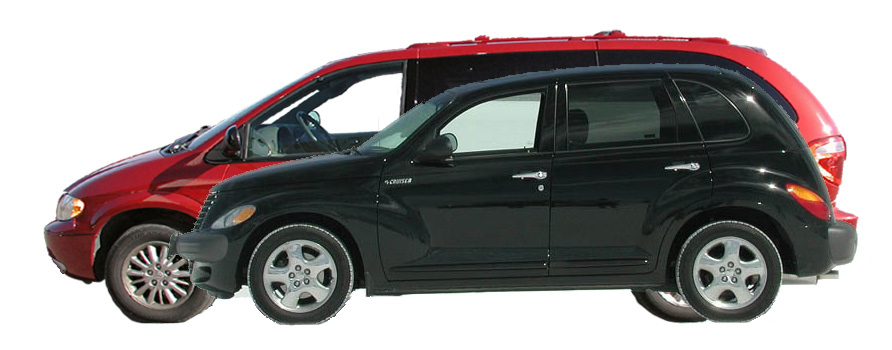
To give an idea of the difference in size between our PT Cruiser and the Queen Mary Dodge Grand Caravan, here are the two models to scale. Our Cruiser is actually "electric blue", not black, but you get the idea. We worked out that, if we had cleared the longer half of the garage and parked the Queen Mary there, we both would have had to leave by the driver-side rear door (the swing-out doors would not have opened in the width available) and climb over the hood to get to the garage door (which would have been dead-center in front of the thing).

On the other hand, we would have been able to fit the bikes in the thing. I have a Rans V-Rex and Lori has a Catrike Speed, so regular bike racks don't work that well for us. Read more!

Sunday, December 25, 2005

Stuff: Christmas Disasters

Once is happenstance, twice is tradition.

Several years ago, we were driving down to my parents' places on Christmas Eve for the family Christmas get-together (a two-hour drive) with our two cats -- and a friend who was also visiting family down there -- and ended up stranded halfway there at 11pm with a ruined alternator. I'm going to skip the details here, but suffice it to say that it took both the CAA and my mother coming up to find us so we could get the car and ourselves to town. That was the first time we'd agreed to drive someone down with us on Christmas Eve.

This year was the second time did so, and our apparent tradition of the car not cooperating manifested itself again.

Christmas Eve, we set out to deliver gifts to my aunt's before driving down to the parents' places. We got in the car, started it up, and GRRND GRRND GRRND GRRND -- not a good sound. The engine started ok, but something was grinding against something in there.

So I got out, and Lori backed the car up a bit so we could pop the hood. First clue as to what went wrong: a large rat leaps out of the wheel well of the car and disappears down a fresh hole under the garage wall.

Second clue: a small pool of a thick red liquid under where the car engine had been.

So we opened the hood and had a look. The third clue: a mass of paper, lint, and fur wedged under the manifold -- apparently, a nest. Also, some of the insulation was chewed off a wire.

Removing the nest didn't fix the problem, so it was time to phone the CAA (to get a tow), the dealership (which was closed), my aunt (to say we wouldn't be delivering the presents just yet), and four or five car rental places. Unfortunately, this was all at about 12:50pm, and all but two of the rental places withing walking distance were closing at 1:00. And one of the two that were open to four had no cars to rent us anyway.

Soon, the CAA guy showed up and got the car hoisted on his truck, at which point we found the source of the red liquid: a second rat wedged quite securely behind the bumper. He towed the car to the dealership, where it will stay until Tuesday when they open again. So we made our way on foot to the Budget Car Rentals that said they had a vehicle.

The vehicle they had was a little intimidating, though. Lori's car is a PT Cruiser. Nice and roomy, but overall pretty small -- it's quite short for it's storage volume. The car we got was a Dodge Grand Caravan, over five meters long. The Cruiser is only four and a quarter meters. We've taken to calling the Caravan "The Queen Mary".

We paced it off -- the Caravan was only 20cm shorter than the inside of our garage. Even if we got it in there, there'd be no way we could use the door, short of climbing over the hood. And, of course, City Hall was closed, so we couldn't get an on-street parking permit.

But we did get the presents delivered. And we did get down to the family Christmas gathering. And back again, through sleet and snow and dark of night.

But we want the little cruiser back!

Follow-ups:
Addendum
Aftermath
Book
Fresh Disasters Read more!

Thursday, December 22, 2005

Joyous Yule

Deck us all with Boston Charlie,
Walla Walla, Wash., an' Kalamazoo!
Nora's freezin' on the trolley,
Swaller dollar cauliflower alley-garoo!

Don't we know archaic barrel
Lullaby Lilla Boy, Louisville Lou?
Trolley Molly don't love Harold,
Boola boola Pensacoola hullabaloo!

Bark us all bow-wows of folly,
Polly wolly cracker 'n' too-da-loo!
Donkey Bonny brays a carol,
Antelope Cantaloupe, 'lope with you!

Hunky Dory's pop is lolly
Gaggin' on the wagon, Willy, folly go through!
Chollie's collie barks at Barrow,
Harum scarum five alarm bung-a-loo!

Dunk us all in bowls of barley,
Hinky dinky dink an' polly voo!
Chilly Filly's name is Chollie,
Chollie Filly's jolly chilly view halloo!

Bark us all bow-wows of folly,
Double-bubble, toyland trouble! Woof, woof, woof!
Tizzy seas on melon collie!
Dibble-dabble, scribble-scrabble! Goof, goof, goof!


Walt Kelly
Read more!

Friday, December 16, 2005

Stuff: It's Author's Week at '77 Track 7

Apparently I'm starting to show up on Google or something. First, Jessica Sachs commends on my post about Corpse, and now Roberto Casati has dropped in on my post about his Shadows.

Thanks for the comments! Read more!

Thursday, December 15, 2005

Book (Science): The Ancestor's Tale

It's been almost a month since I started Richard Dawkins's
The Ancestor's Tale: A Pilgrimage to the Dawn of Life. It's a pretty hefty book, and I got interrupted a few times.

It's hefty, but it's fascinating. There was a lot of good material I hadn't seen before, or only new about vaguely, and the novel presentation put an interesting perspective on everything.

As I mentioned in my preview post, the book is told as a backwards trip through the evolutionary tree, starting with modern humans, with a chapter at each of the branching points between our history and that of any still-surviving cousins we have. Dawkins calls these branching points "rendezvous" (since we're going backwards) and refers to the last common ancestor between the two branches as the "concestor" for that rendezvous. For example, Rendezvous 17 is with the amphibians, and concestor 17 would be the last animal who had some descendants who went on to become modern amphibians and other descendants who went on to become humans. Naturally -- and this is an important point Dawkins repeats often for the various concestors -- concestor 17 was not an modern amphibian itself! That may seem obvious, but when Larry King asks questions like "If evolution is true, why are there still monkeys?" on his show, it's a point that's obviously lost on many people.

Each Rendezvous has its own chapter, and most of those consist of one or more tales of modern animals from the other branch. For example, Rendezvous 26 -- Protosomes -- is where the our branch and the one that would give rise to insects, crustaceans, spiders, worms, and so on, join. That chapter includes The Ragworm's Tale, The Brine Shrimp's Tale, The Fruit Fly's Tale, etc.

What wasn't clear when I wrote my preview post, though, was that the animals in these tales are actually excuses to tell much more varied tales than just histories of various evolutionary paths. Rather, Dawkins uses them to explore evolutionary concepts exemplified by the subject species. The Fruit Fly's Tale deals primarily with Hox genes (whose function were first determined through experiments on fruit flies). Hox genes are responsible for turning other genes on and off within a cell based on a cell's position within a body: they're what make arms become arms and legs become legs (among other things). Mutations in Hox genes in fruit flies can turn antennae into legs or give the fly extra wings.

Similarly, The Platypus's Tale is about electro-sensitivity (platypuses can detect electrical fields with their bill), The Redwood Tale is about dating methods (starting with dendrochronology, taking by patterns of tree rings), The Salamander's Tale is about ring species and racial distinctions, and so on.

There are also two summary chapters at the end, Cantebury and The Host Returns. Cantebury represents the start of it all, the root of the tree from which all these Rendezvous descend, and Dawkins uses it to talk about important first step in evolution. Not so much the origin of life, but the origin of heredity -- without heredity, you can't have evolution. He discusses a fascinating experiment I hadn't ever heard of, done using a RNA virus called Qβ.

Qβ, like any virus, is a genetic parasite which hijacks a cell's DNA/RNA transcription systems to make copies of itself and the proteins that it uses (one to enclose the RNA, one to stick the virus to the cell, one to destroy the cell to let the copies free, and one that assembles the Qβ copying protein, Qβ replicase, out of proteins found in the cell).

The experiment consisted of putting Qβ RNA and Qβ replicase in test tubes away from any cells to see what happened. Before long, even without the cell's full-fledge copying system on hand, the Qβ was being copied. Not only that, but as the experiment was iterated through successive "generations" (samples from one experiment moved to a fresh test tube), the Qβ RNA changed, loosing the genes that encoded the shell, glue, or escape proteins, since they weren't needed in the test tube environment. The Qβ RNA was reduced from 3600 codons to only 550. In some experiments, the Qβ RNA wasn't even necessary: the experimenter simply mixed raw material for making RNA with Qβ replicase, and soon a very Qβ-like RNA virus appeared.

Dawkins found this interesting because it demonstrated that you could have an evolving system with heredity with only RNA (or RNA components) and a single protein. I found it interesting because it reminded me of Tierra and Avida, experiments in genetic programming. Tierra lets you write short, self-replicating computer programs and then runs them in an environment where they are subject to selection pressures and mutation. Avida is based on Tierra.

One of the early results from Tierra (or maybe Avida, I can't remember which one this actually happened on -- maybe both) was a program which, through evolution in the system, shortened itself substantially, making itself more successful by reducing the amount of steps it took to copy itself. In fact, the code was tightened so much that it was hard for the developers watching it to figure out how it worked -- it was more optimized than any human author would think they could make it.

This being Dawkins, there are some interesting sociology-of-science bits as well. Naturally, he discusses the shortcomings of creationism in addressing the results biologists have been getting in their research, and throws in a couple of light barbs at creationists' tendencies to quote biologists selectively. Though the thing he harps on most of all is how the rules of biological nomenclature have stuck us with a number of rather inappropriate names for species, processes, and theories. Unfortunately, I didn't think to make notes of examples, and they're rather hard to find by flipping through the book.

My only real complaint about The Ancestor's Tale is Dawkins's writing style. His tone tends to wobble between lectorial and conversational, rather than going for one or the other -- or striking a balance somewhere in between. It's not at all a major problem, but it did make the book's flow a little uneven in places. Still, he got to marry Romana after being introduced to her by Douglas Adams. I suppose it'd be too much to expect him to write like Isaac Asimov on top of all that. Read more!

Stuff: This is cool

You probably haven't noticed -- unless you actually make a habit of watching for new comments on two-month-old posts -- but a couple of days ago I had an unexpected visitor at my post on Jessica Snyder Sachs's book on forensics, Corpse -- namely, Jessica Sachs herself.

Corpse was a fun book (and one that comes to mind any time any of the CSI coroners makes a pronouncement about time of death). Sachs is now working on "a book about the microbes that colonize our bodies while we're still alive", which may be less -- or maybe more -- disturbing that her stories about the ones that colonize our bodies after we're dead.

She has her own weblog at http://www.jessicasachs.com/ -- be sure to drop by. Read more!

Monday, December 12, 2005

Photography: Toronto Winter

I just put a large batch of photos up on Flickr. Most of them are from theDecember 9th snowfall, with a few cat photos added in as usual. Read more!

Thursday, December 08, 2005

Stuff: Celebrity Spotting

I'm not a big one for celebrity spotting -- largely because I'm not a big one for celebrities, period -- but sometimes it's unavoidable in a city like Toronto. Lori and I had one such encounter yesterday while heading downtown to pick up some friends for a tour of the city: while we were stopped at Esplanade and Sherbourne, George A. Romero, the King of the Zombies, wandered across the street in front of us, chatting with a friend or colleague. I wouldn't have had any reason to recognize him, had I not met him at Nash the Slash's View from a Gallery show and taken photographs.

Romero filmed Land of the Dead (which I haven't seen yet) here in Toronto -- he was in post-production when he dropped in on Nash's show. I don't know what he's working on now. Read more!

Wednesday, December 07, 2005

Book (Science): The Cartoon Guide to Chemistry

The Ancestor's Tale falls further and further behind. No fault of Richard Dawkins's, though -- just circumstances and my own reading habits.

For some reason I seem to mentally classify books as "the one I'm reading at work" and "the one I'm reading at home". ("Reading at work" here means reading while walking to/from work and to/during/from workday lunch.) The Ancestor's Tale is currently stuck in the "reading at work" category, so I rarely even think of picking it up at home. Which I should, or I'll never get through it.

This weekend was a little odd, though, because on Saturday I ended up stuck at Lori's work while she and her crew dealt with a software deployment. And I didn't have my "reading at work" book (or any book) with me. So I ran out to Indigo at the Eaton Centre to see what I could find.

This was one of those serendipedous trips -- I just happened to trip over a new Larry Gonick Cartoon Guide!

For those who don't know Gonicks books (The Cartoon Guide to Physics, The Cartoon Guide to Statistics, The Cartoon Guide to Genetics, The Cartoon History of the Universe, etc), they are some of the best introductory guides to their subjects around. As good as or better than most of the non-cartoon introductions to those subjects. Gonick (often writing with help from experts, but sometimes alone) doesn't believe in giving a superficial overview. The stats book gets into Baysian analysis; the physics book into quantum mechanics (without the woo-woo mysticism that haunts a lot of popular books on the subject); the history of the universe book actually covers Africa, India, and China quite well (which is unusual for popular general histories in North America, which concentrate heavily on Europe). They're not what you'd expect from a book of cartoons. Sure, they wouldn't take the place of textbooks, but they do make great supplemental material.

The Cartoon Guide to Chemistry actually started off disappointingly, though. The first chapter covers the history of chemistry very quickly. It soon became obvious that this was because Gonick wasn't going to be writing about the history of chemistry -- he needed all the space he could get for the actual science! By halfway through the book he's well beyond anything that I took in high school chemistry. In fact, he introduces material that I'd never even heard of before, such as "enthalpy" (which he describes as "possibly the ugliest word in chemistry"). I was always more math and physics than chemistry, but I'm pretty sure that the term never came up in Mr. Stephina's class. Of course, he was always so busy blowing stuff up, I might have missed it.

The book contains some of the best and most intuitive explanations for the different kinds of chemical bonds, and how their differing natures affect chemical reactions they get involved in. Gonick also has a great (and detailed) overview of the nature of acids and bases and how they're related. He ends with a section on electrochemistry that revolves around how to calculate the voltage you'll get from different kinds of chemical batteries -- I had never seen this material presented before, so it was fascinating.

I have to admit, though, that trying to read the book through in a single sitting (trapped, as I was, at Lori's office) got rather tiring. Things like deriving the base ionization constant tended to make my eyes glaze over. I don't know if it's because this book gets into more detail than the physics or statistics ones, or if it's just because I'd always been better at physics and stats than chemistry, but I did find it a little overwhelming at times. If I'd taken the time to work through the examples, it probably would have sunk in better, but I was reading to relax, not work!

In any case, it's yet another great Gonick guide. I'm still missing a few from my collection, so I've got to fill those holes in. Read more!

Thursday, December 01, 2005

Books (Comic Strip): Thriving on Vague Objectives

I wandered into the local Chapters looking for a copy of Sweet Silver Blues, the first Garrett, PI book (I can't find our copy at home) and discovered that there was a new Dilbert book out, Thriving on Vague Objectives.

I've been following Dilbert since before the first strip collections came out, and my Dilbert-quoting habit is almost as bad as my Python and Goon Show quoting, and the latest book is as good as any (and has a shorter title than many of the more recent ones). I've occasionally had a few problems with Scott Adams, though.

Adams has some great insight into the absurdity of corporate life, but he's got a very bizarre notion of how science works. It's generally not a problem, but every once in a while it crops up in his books or (most recently) his new weblog, in which he declared that the Intelligent Design folks and biologists were equally bad at their arguments, and not only did each not really understand the other's argument, they didn't even really understand their own.

This was a very odd claim, given that, over the course of the rest of the post, it became obvious that Adams himself understood the least about the matter of the three of them.

PK Myers at Pharyngula posted a good rebuttal which summarizes the whole thing quite nicely. What was most odd, though, was Adams's response to Myers. Adams said that the problem really is that there are "no credible people" to inform him about the subject, and that (most amazingly) no one who has a professional stake in a matter can be considered credible on that matter -- and that the more stake you have, the less credible you are.

I can even see Adams's point -- within a corporate context. In the politics-heavy world of a business, very often the people most pushing for project A or project B are completely non-credible. And, of course, then there's marketing and advertising.

But outside of that -- are engineers really the least credible people when it comes to how to build a bridge? Doctors the least credible about medicine? Lawyers the least credible about law? No matter how much you might dislike lawyers, they do know more about law (on the whole) than non-lawyers.

That's when I decided that I wasn't going to follow the Dilbert Blog anymore -- I didn't want it to spoil my enjoyment of the strip. And I did enjoy the latest book! It had a number of strips I laughed out loud at over lunch. The last couple of collections were fun, but didn't have anything outstanding in them. This one has some really great strips.

I just have to remember that Adams lives in a world of Pointy-Haired Bosses... Read more!