Friday, December 30, 2005

Stuff: Toronto Hawks

I'm kind of between books at the moment. After The Ancestor's Tale I'm having a hard time getting into anything else. I've started a couple of things, but haven't been all that engrossed by them.

Usually what I do when I'm in this sort of state is get out one of my old standby series out -- Lois McMaster Bujold or David Eddings or Glen Cook, for example -- and plow through them. Specifically, I wanted to re-read Cook's Garrett P.I. books, but I can't find the first volume (Sweet Silver Blues) either at home or in book stores, and I don't want to read them out of order. So I'm at a loss for books right now.

All of this is completely irrelevant to Toronto hawks, except to explain why I'm not posting about them and not books. The hawks -- well, one hawk -- came in this afternoon on our way back from groceries. We noticed a couple of flocks of synchronized pigeons circling over the street. We found that a little odd, as Toronto pigeons are not known for exerting themselves, until we noticed why they were flapping around: they were chasing a hawk, who fled the pigeon-infested area and settled down on a TV aerial on a nearby building.

Fortunately, this was quite close to home, so I ran in and got the camera. It was rather tricky photographing a hawk that was ten stories higher than me -- with the aerial in the way to boot -- but I did get a couple of not-bad shots. The image links to the shot on Flickr, where you find the best of the shots. Read more!

Wednesday, December 28, 2005

Stuff: Christmas Disaster Aftermath

We finally have back our PT Cruiser, without so much rat in it. Final damage report: they had to replace the spark plugs, several well-chewed belts, and a number of electrical wires. And they had to shampoo the engine to get all the little bits of rat out.

For the next little while, we'll be slapping the hood a few times before driving off... Read more!

Tuesday, December 27, 2005

Stuff: Christmas Disaster Addendum

To give an idea of the difference in size between our PT Cruiser and the Queen Mary Dodge Grand Caravan, here are the two models to scale. Our Cruiser is actually "electric blue", not black, but you get the idea. We worked out that, if we had cleared the longer half of the garage and parked the Queen Mary there, we both would have had to leave by the driver-side rear door (the swing-out doors would not have opened in the width available) and climb over the hood to get to the garage door (which would have been dead-center in front of the thing).

On the other hand, we would have been able to fit the bikes in the thing. I have a Rans V-Rex and Lori has a Catrike Speed, so regular bike racks don't work that well for us. Read more!

Sunday, December 25, 2005

Stuff: Christmas Disasters

Once is happenstance, twice is tradition.

Several years ago, we were driving down to my parents' places on Christmas Eve for the family Christmas get-together (a two-hour drive) with our two cats -- and a friend who was also visiting family down there -- and ended up stranded halfway there at 11pm with a ruined alternator. I'm going to skip the details here, but suffice it to say that it took both the CAA and my mother coming up to find us so we could get the car and ourselves to town. That was the first time we'd agreed to drive someone down with us on Christmas Eve.

This year was the second time did so, and our apparent tradition of the car not cooperating manifested itself again.

Christmas Eve, we set out to deliver gifts to my aunt's before driving down to the parents' places. We got in the car, started it up, and GRRND GRRND GRRND GRRND -- not a good sound. The engine started ok, but something was grinding against something in there.

So I got out, and Lori backed the car up a bit so we could pop the hood. First clue as to what went wrong: a large rat leaps out of the wheel well of the car and disappears down a fresh hole under the garage wall.

Second clue: a small pool of a thick red liquid under where the car engine had been.

So we opened the hood and had a look. The third clue: a mass of paper, lint, and fur wedged under the manifold -- apparently, a nest. Also, some of the insulation was chewed off a wire.

Removing the nest didn't fix the problem, so it was time to phone the CAA (to get a tow), the dealership (which was closed), my aunt (to say we wouldn't be delivering the presents just yet), and four or five car rental places. Unfortunately, this was all at about 12:50pm, and all but two of the rental places withing walking distance were closing at 1:00. And one of the two that were open to four had no cars to rent us anyway.

Soon, the CAA guy showed up and got the car hoisted on his truck, at which point we found the source of the red liquid: a second rat wedged quite securely behind the bumper. He towed the car to the dealership, where it will stay until Tuesday when they open again. So we made our way on foot to the Budget Car Rentals that said they had a vehicle.

The vehicle they had was a little intimidating, though. Lori's car is a PT Cruiser. Nice and roomy, but overall pretty small -- it's quite short for it's storage volume. The car we got was a Dodge Grand Caravan, over five meters long. The Cruiser is only four and a quarter meters. We've taken to calling the Caravan "The Queen Mary".

We paced it off -- the Caravan was only 20cm shorter than the inside of our garage. Even if we got it in there, there'd be no way we could use the door, short of climbing over the hood. And, of course, City Hall was closed, so we couldn't get an on-street parking permit.

But we did get the presents delivered. And we did get down to the family Christmas gathering. And back again, through sleet and snow and dark of night.

But we want the little cruiser back!

Follow-ups:
Addendum
Aftermath
Book
Fresh Disasters Read more!

Thursday, December 22, 2005

Joyous Yule

Deck us all with Boston Charlie,
Walla Walla, Wash., an' Kalamazoo!
Nora's freezin' on the trolley,
Swaller dollar cauliflower alley-garoo!

Don't we know archaic barrel
Lullaby Lilla Boy, Louisville Lou?
Trolley Molly don't love Harold,
Boola boola Pensacoola hullabaloo!

Bark us all bow-wows of folly,
Polly wolly cracker 'n' too-da-loo!
Donkey Bonny brays a carol,
Antelope Cantaloupe, 'lope with you!

Hunky Dory's pop is lolly
Gaggin' on the wagon, Willy, folly go through!
Chollie's collie barks at Barrow,
Harum scarum five alarm bung-a-loo!

Dunk us all in bowls of barley,
Hinky dinky dink an' polly voo!
Chilly Filly's name is Chollie,
Chollie Filly's jolly chilly view halloo!

Bark us all bow-wows of folly,
Double-bubble, toyland trouble! Woof, woof, woof!
Tizzy seas on melon collie!
Dibble-dabble, scribble-scrabble! Goof, goof, goof!


Walt Kelly
Read more!

Friday, December 16, 2005

Stuff: It's Author's Week at '77 Track 7

Apparently I'm starting to show up on Google or something. First, Jessica Sachs commends on my post about Corpse, and now Roberto Casati has dropped in on my post about his Shadows.

Thanks for the comments! Read more!

Thursday, December 15, 2005

Book (Science): The Ancestor's Tale

It's been almost a month since I started Richard Dawkins's
The Ancestor's Tale: A Pilgrimage to the Dawn of Life. It's a pretty hefty book, and I got interrupted a few times.

It's hefty, but it's fascinating. There was a lot of good material I hadn't seen before, or only new about vaguely, and the novel presentation put an interesting perspective on everything.

As I mentioned in my preview post, the book is told as a backwards trip through the evolutionary tree, starting with modern humans, with a chapter at each of the branching points between our history and that of any still-surviving cousins we have. Dawkins calls these branching points "rendezvous" (since we're going backwards) and refers to the last common ancestor between the two branches as the "concestor" for that rendezvous. For example, Rendezvous 17 is with the amphibians, and concestor 17 would be the last animal who had some descendants who went on to become modern amphibians and other descendants who went on to become humans. Naturally -- and this is an important point Dawkins repeats often for the various concestors -- concestor 17 was not an modern amphibian itself! That may seem obvious, but when Larry King asks questions like "If evolution is true, why are there still monkeys?" on his show, it's a point that's obviously lost on many people.

Each Rendezvous has its own chapter, and most of those consist of one or more tales of modern animals from the other branch. For example, Rendezvous 26 -- Protosomes -- is where the our branch and the one that would give rise to insects, crustaceans, spiders, worms, and so on, join. That chapter includes The Ragworm's Tale, The Brine Shrimp's Tale, The Fruit Fly's Tale, etc.

What wasn't clear when I wrote my preview post, though, was that the animals in these tales are actually excuses to tell much more varied tales than just histories of various evolutionary paths. Rather, Dawkins uses them to explore evolutionary concepts exemplified by the subject species. The Fruit Fly's Tale deals primarily with Hox genes (whose function were first determined through experiments on fruit flies). Hox genes are responsible for turning other genes on and off within a cell based on a cell's position within a body: they're what make arms become arms and legs become legs (among other things). Mutations in Hox genes in fruit flies can turn antennae into legs or give the fly extra wings.

Similarly, The Platypus's Tale is about electro-sensitivity (platypuses can detect electrical fields with their bill), The Redwood Tale is about dating methods (starting with dendrochronology, taking by patterns of tree rings), The Salamander's Tale is about ring species and racial distinctions, and so on.

There are also two summary chapters at the end, Cantebury and The Host Returns. Cantebury represents the start of it all, the root of the tree from which all these Rendezvous descend, and Dawkins uses it to talk about important first step in evolution. Not so much the origin of life, but the origin of heredity -- without heredity, you can't have evolution. He discusses a fascinating experiment I hadn't ever heard of, done using a RNA virus called Qβ.

Qβ, like any virus, is a genetic parasite which hijacks a cell's DNA/RNA transcription systems to make copies of itself and the proteins that it uses (one to enclose the RNA, one to stick the virus to the cell, one to destroy the cell to let the copies free, and one that assembles the Qβ copying protein, Qβ replicase, out of proteins found in the cell).

The experiment consisted of putting Qβ RNA and Qβ replicase in test tubes away from any cells to see what happened. Before long, even without the cell's full-fledge copying system on hand, the Qβ was being copied. Not only that, but as the experiment was iterated through successive "generations" (samples from one experiment moved to a fresh test tube), the Qβ RNA changed, loosing the genes that encoded the shell, glue, or escape proteins, since they weren't needed in the test tube environment. The Qβ RNA was reduced from 3600 codons to only 550. In some experiments, the Qβ RNA wasn't even necessary: the experimenter simply mixed raw material for making RNA with Qβ replicase, and soon a very Qβ-like RNA virus appeared.

Dawkins found this interesting because it demonstrated that you could have an evolving system with heredity with only RNA (or RNA components) and a single protein. I found it interesting because it reminded me of Tierra and Avida, experiments in genetic programming. Tierra lets you write short, self-replicating computer programs and then runs them in an environment where they are subject to selection pressures and mutation. Avida is based on Tierra.

One of the early results from Tierra (or maybe Avida, I can't remember which one this actually happened on -- maybe both) was a program which, through evolution in the system, shortened itself substantially, making itself more successful by reducing the amount of steps it took to copy itself. In fact, the code was tightened so much that it was hard for the developers watching it to figure out how it worked -- it was more optimized than any human author would think they could make it.

This being Dawkins, there are some interesting sociology-of-science bits as well. Naturally, he discusses the shortcomings of creationism in addressing the results biologists have been getting in their research, and throws in a couple of light barbs at creationists' tendencies to quote biologists selectively. Though the thing he harps on most of all is how the rules of biological nomenclature have stuck us with a number of rather inappropriate names for species, processes, and theories. Unfortunately, I didn't think to make notes of examples, and they're rather hard to find by flipping through the book.

My only real complaint about The Ancestor's Tale is Dawkins's writing style. His tone tends to wobble between lectorial and conversational, rather than going for one or the other -- or striking a balance somewhere in between. It's not at all a major problem, but it did make the book's flow a little uneven in places. Still, he got to marry Romana after being introduced to her by Douglas Adams. I suppose it'd be too much to expect him to write like Isaac Asimov on top of all that. Read more!

Stuff: This is cool

You probably haven't noticed -- unless you actually make a habit of watching for new comments on two-month-old posts -- but a couple of days ago I had an unexpected visitor at my post on Jessica Snyder Sachs's book on forensics, Corpse -- namely, Jessica Sachs herself.

Corpse was a fun book (and one that comes to mind any time any of the CSI coroners makes a pronouncement about time of death). Sachs is now working on "a book about the microbes that colonize our bodies while we're still alive", which may be less -- or maybe more -- disturbing that her stories about the ones that colonize our bodies after we're dead.

She has her own weblog at http://www.jessicasachs.com/ -- be sure to drop by. Read more!

Monday, December 12, 2005

Photography: Toronto Winter

I just put a large batch of photos up on Flickr. Most of them are from theDecember 9th snowfall, with a few cat photos added in as usual. Read more!

Thursday, December 08, 2005

Stuff: Celebrity Spotting

I'm not a big one for celebrity spotting -- largely because I'm not a big one for celebrities, period -- but sometimes it's unavoidable in a city like Toronto. Lori and I had one such encounter yesterday while heading downtown to pick up some friends for a tour of the city: while we were stopped at Esplanade and Sherbourne, George A. Romero, the King of the Zombies, wandered across the street in front of us, chatting with a friend or colleague. I wouldn't have had any reason to recognize him, had I not met him at Nash the Slash's View from a Gallery show and taken photographs.

Romero filmed Land of the Dead (which I haven't seen yet) here in Toronto -- he was in post-production when he dropped in on Nash's show. I don't know what he's working on now. Read more!

Wednesday, December 07, 2005

Book (Science): The Cartoon Guide to Chemistry

The Ancestor's Tale falls further and further behind. No fault of Richard Dawkins's, though -- just circumstances and my own reading habits.

For some reason I seem to mentally classify books as "the one I'm reading at work" and "the one I'm reading at home". ("Reading at work" here means reading while walking to/from work and to/during/from workday lunch.) The Ancestor's Tale is currently stuck in the "reading at work" category, so I rarely even think of picking it up at home. Which I should, or I'll never get through it.

This weekend was a little odd, though, because on Saturday I ended up stuck at Lori's work while she and her crew dealt with a software deployment. And I didn't have my "reading at work" book (or any book) with me. So I ran out to Indigo at the Eaton Centre to see what I could find.

This was one of those serendipedous trips -- I just happened to trip over a new Larry Gonick Cartoon Guide!

For those who don't know Gonicks books (The Cartoon Guide to Physics, The Cartoon Guide to Statistics, The Cartoon Guide to Genetics, The Cartoon History of the Universe, etc), they are some of the best introductory guides to their subjects around. As good as or better than most of the non-cartoon introductions to those subjects. Gonick (often writing with help from experts, but sometimes alone) doesn't believe in giving a superficial overview. The stats book gets into Baysian analysis; the physics book into quantum mechanics (without the woo-woo mysticism that haunts a lot of popular books on the subject); the history of the universe book actually covers Africa, India, and China quite well (which is unusual for popular general histories in North America, which concentrate heavily on Europe). They're not what you'd expect from a book of cartoons. Sure, they wouldn't take the place of textbooks, but they do make great supplemental material.

The Cartoon Guide to Chemistry actually started off disappointingly, though. The first chapter covers the history of chemistry very quickly. It soon became obvious that this was because Gonick wasn't going to be writing about the history of chemistry -- he needed all the space he could get for the actual science! By halfway through the book he's well beyond anything that I took in high school chemistry. In fact, he introduces material that I'd never even heard of before, such as "enthalpy" (which he describes as "possibly the ugliest word in chemistry"). I was always more math and physics than chemistry, but I'm pretty sure that the term never came up in Mr. Stephina's class. Of course, he was always so busy blowing stuff up, I might have missed it.

The book contains some of the best and most intuitive explanations for the different kinds of chemical bonds, and how their differing natures affect chemical reactions they get involved in. Gonick also has a great (and detailed) overview of the nature of acids and bases and how they're related. He ends with a section on electrochemistry that revolves around how to calculate the voltage you'll get from different kinds of chemical batteries -- I had never seen this material presented before, so it was fascinating.

I have to admit, though, that trying to read the book through in a single sitting (trapped, as I was, at Lori's office) got rather tiring. Things like deriving the base ionization constant tended to make my eyes glaze over. I don't know if it's because this book gets into more detail than the physics or statistics ones, or if it's just because I'd always been better at physics and stats than chemistry, but I did find it a little overwhelming at times. If I'd taken the time to work through the examples, it probably would have sunk in better, but I was reading to relax, not work!

In any case, it's yet another great Gonick guide. I'm still missing a few from my collection, so I've got to fill those holes in. Read more!

Thursday, December 01, 2005

Books (Comic Strip): Thriving on Vague Objectives

I wandered into the local Chapters looking for a copy of Sweet Silver Blues, the first Garrett, PI book (I can't find our copy at home) and discovered that there was a new Dilbert book out, Thriving on Vague Objectives.

I've been following Dilbert since before the first strip collections came out, and my Dilbert-quoting habit is almost as bad as my Python and Goon Show quoting, and the latest book is as good as any (and has a shorter title than many of the more recent ones). I've occasionally had a few problems with Scott Adams, though.

Adams has some great insight into the absurdity of corporate life, but he's got a very bizarre notion of how science works. It's generally not a problem, but every once in a while it crops up in his books or (most recently) his new weblog, in which he declared that the Intelligent Design folks and biologists were equally bad at their arguments, and not only did each not really understand the other's argument, they didn't even really understand their own.

This was a very odd claim, given that, over the course of the rest of the post, it became obvious that Adams himself understood the least about the matter of the three of them.

PK Myers at Pharyngula posted a good rebuttal which summarizes the whole thing quite nicely. What was most odd, though, was Adams's response to Myers. Adams said that the problem really is that there are "no credible people" to inform him about the subject, and that (most amazingly) no one who has a professional stake in a matter can be considered credible on that matter -- and that the more stake you have, the less credible you are.

I can even see Adams's point -- within a corporate context. In the politics-heavy world of a business, very often the people most pushing for project A or project B are completely non-credible. And, of course, then there's marketing and advertising.

But outside of that -- are engineers really the least credible people when it comes to how to build a bridge? Doctors the least credible about medicine? Lawyers the least credible about law? No matter how much you might dislike lawyers, they do know more about law (on the whole) than non-lawyers.

That's when I decided that I wasn't going to follow the Dilbert Blog anymore -- I didn't want it to spoil my enjoyment of the strip. And I did enjoy the latest book! It had a number of strips I laughed out loud at over lunch. The last couple of collections were fun, but didn't have anything outstanding in them. This one has some really great strips.

I just have to remember that Adams lives in a world of Pointy-Haired Bosses... Read more!

Tuesday, November 22, 2005

Books (Fantasy): Whispering Nickel Idols

My wrap-up post on The Ancestor's Tale got delayed a little when, over the weekend, I happened to notice that Glen Cook has a new Garrett book out: Whispering Nickel Idols. Garrett books are on my "must read immediately, then re-read the whole series" list, so everything else got side-tracked.

Cook's Garrett novels are hard-boiled detective fantasy novels -- Mickey Spilane meets Mother Goose, Brothers Grim, various mythologies, and Tolkien. Cook is better known for his Black Company series, which is good but very dark (I have to be in a proper mood to read any of them). The Garrett books are much lighter to read, but are often still dark.

I don't actually read a lot -- well, any -- hard-boiled detective novels, so I can't actually compare the Garrett books to the original genre directly. Just as I first encountered many popular songs via covers or parodies, I know noir best through imitations and spoofs. Still, the basics are pretty well known, and are all found in Garrett: the tough-but-honest, perpetually broke, skirt-chasing gumshoe; the cops who don't trust him; the crime bosses; etc. But Cook puts them in an unusual setting.

Garrett's adventures take place in a fantasy world that draws from just about every fantasy tradition out there. Just about every sort of mythological beastie can be found in Garrett's home city of TunFaire: elves (Tolkien type, not Keebler), trolls, centaurs, dwaves, pixies, and so on. The city is the most cosmopolitan part of a human kingdom which was, through the first half of the series, at war with a neighbouring country -- though, apart from flashbacks to Garrett's life as a Marine during the war, most of the stories take place within a day's ride of town.

While the genre is definitely fantasy, the time period is more pre-Industrial Revolution than medieval, with some notable oddities. There are no firearms, for example, presumably because sorcerers with overdramatic names (that Garrett likes to poke fun of in his narrative) like Stormwarden Raver Styx handle all the heavy artillery during wartime. But the most recent few books have included background stories involving early forms of mass production.

One of the most enjoyable things about the Garrett books is how each novel builds on the previous ones. Each one is sufficiently self-contained to be read on its own, but if you read them in order you can follow background story arcs which span several novels each, enriching the world Cook's inventing. Many of the stories are simply there to do just that, but some also eventually become foreground stories in later novels.

Another aspect of the Garrett books is that, in spite of the relatively frivolous-seeming genre (Sam Spade and the Seven Dwarves!), the novels can be quite dark. It's not uncommon that the solution to the mystery leaves no-one happy. Old Tin Sorrows, which revolves around haunts and zombies and introduces the character of Elenor who stays with Garrett through all the subsequent novels -- even through she was long dead by the time the novel starts -- comes to mind.

Whispering Nickle Idols (you may have noticed that the titles I've mentioned have the form [adjective] [metal] [plural noun] -- all of the titles in the series do that) is one of the more upbeat of the novels, involving infighting among factions of TunFaire's organized crime and an out-of-town cult that derives its strength from terror and dispair. But all of the recurring characters survive this volume (something that is not guaranteed in these novels) and some of the more deranged and/or miserable ones have some hope for the future.

My least favourite thing about a new Garrett book coming out is that it means that it'll probably be another three years until the next one. And Lois McMaster Bujold's Miles Verkosigan books -- a space opera series I also enjoy -- don't really fill the gap.

That and the way Roc Fantasy insists on using cover art that shows Garrett in a fedora, when the books mention -- several times -- that he hates wearing hats. (In one novel, Garrett disguises himself by simply putting a hat on and affecting a limp, since he knows that those looking for him know that he never wears a hat.) For some reason, the Garrett cover art always includes both elements from the novel (in this case, pixies, Belinda Contague, and a bucket of kittens) and elements that appear nowhere in the novel at all (the fedora, and, in this case, a tentacle-haired fish-creature and a Star-Trek-alien looking guy with horns and a goatee). Read more!

Friday, November 18, 2005

Music: Friday Random Ten


  1. Hardware Store
    "Weird Al" Yankovic
    Poodle Hat

    This is one of my favourite Weird Al songs. So far as I know it's an Al original, not a parody of an existing song or band. The best part is the list of items you find at the hardware store, performed with some great harmonies:

    They've got allen wrenches, gerbil feeders, toilet seats, electric heaters
    Trash compactors, juice extractor, shower rods and water meters
    Walkie-talkies, copper wires safety goggles, radial tires
    BB pellets, rubber mallets, fans and dehumidifiers
    Picture hangers, paper cutters, waffle irons, window shutters
    Paint removers, window louvres, masking tape and plastic gutters
    Kitchen faucets, folding tables, weather stripping, jumper cables
    Hooks and tackle, grout and spackle, power foggers, spoons and ladles
    Pesticides for fumigation, high-performance lubrication
    Metal roofing, water proofing, multi-purpose insulation
    Air compressors, brass connectors, wrecking chisels, smoke detectors
    Tire guages, hamster cages, thermostats and bug deflectors
    Trailer hitch demagnetizers, automatic circumcisers
    Tennis rackets, angle brackets, Duracells and Energizers
    Soffit panels, circuit brakers, vacuum cleaners, coffee makers
    Calculators, generators, matching salt and pepper shakers

  2. The Sour Song
    The Residents
    Our Finest Flowers

    Back in my discussion of The Way We Were, I mentioned The Residents' fondness for revisiting their past over and over. One of the major examples of that was the album Our Finest Flowers, a "Greatest Hits" album in which the hits are mixed and matched into new songs.

  3. CARNIVAL
    Shinkichi Mitsumune
    FLCL 1 - Addict

    A fairly generic piece of TV soundtarck music. FLCL was a fun series, with some not-bad music, but this one doesn't stand out much at all.

  4. Goin' Under
    Devo
    E-Z Listening Disc

    Like The Residents with Our Finest Flowers, Devo made a tribute album to themselves, only instead of doing mashups, they muzakified their songs. It's more of a completist's album, though -- a side-project curiousity.

  5. Things Are Looking Bad for Santa
    The Arrogant Worms
    Christmas Turkey

    Lori hates the Christmas season, for a variety of reasons, so one tradition around our place is satirical Christmas songs (or "unChristmas Carols", as we call them). Her all-time favourite is Weird Al's The Night Santa Went Crazy (the live version, where Santa doesn't survive). We also have lots of Bob Rivers Christmas albums and we just picked up the Howard Philip Lovecraft Historical Society's A Very Scary Solstice. The Arrogant Worms' Christmas Turkey has some good songs, but (again) this isn't one of the better ones on the album.

  6. Shine On You Crazy Diamond
    Pink Floyd
    Pulse

    This, however, is one of the best Pink Floyd songs. I'm not a big fan of their Syd Barrett period, but their post-Barrett tribute to Barrett is an amazing piece of music. Doug Gilmore's four-note guitar entry always sends shivers up my spine.

  7. New Orleans
    The Residents
    Stranger Than Supper

    A short instrumental from the first CD released by the Residents fan club, "Uncle Willie's Eyeball Buddies".

  8. It's No Game (Part 1)
    David Bowie
    Scary Monsters

    Many of my favourite Bowie songs are the ones where he starts going off into weird harmonies and rhythms, and this one qualifies.

  9. Time
    Pink Floyd
    Delicate Sound of Thunder

    Another great live Floyd track.


A bit of a mixed bag this week. A lot of so-so tracks in the first half, but some really good ones in the second. Read more!

Thursday, November 17, 2005

Books (Science): The Ancestor's Tale (Preview)

I just picked up a book that's rather thicker than the other ones I've been reading lately: The Ancestor's Tale: A Pilgrimage to the Dawn of Life by Richard Dawkins. At about 630 pages before the bibliography and index, it's around twice as long as most of the other books I've talked about here. So I'm going to do a little preview post now, and follow up later when I finish.

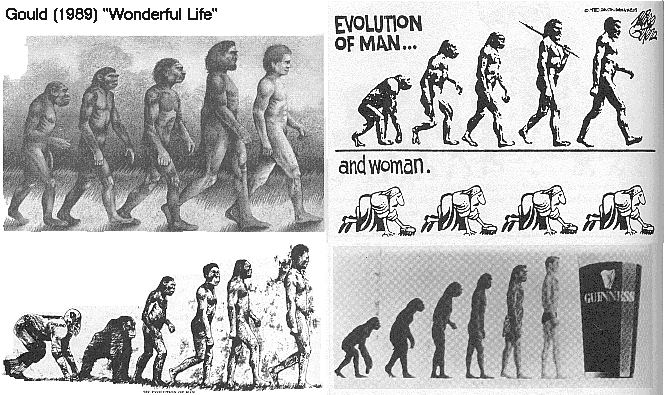
One of the images that says "evolution" more than any other to the average person is the much-spoofed drawing of a sequence of species running from fish to humans. This image bothers many scientists because it embraces a long-discredited notion that evolution is directed forward towards something (namely, us), when it is, in fact, purely driven by contingency -- what happens in evolution is completely dependent on the past and the present, with no looking forward.

In The Ancestor's Tale, Dawkins reverses things and runs the sequence back from us through the 40 major branchings that have happened in our family tree, towards the common ancestor to all modern life -- sort of like the recent Guiness commercial that made it's rounds on the Web (though the ad has some major mistakes in the species used). Since one can look back without suggesting predestination, this makes for a less misleading perspective on evolution.

As you might have guessed from the title's form and its reference to a pilgramage, The Ancestor's Tale's structure is based loosely on Chaucer's Cantebury Tales. Dawkins tells the tales of the modern descendants from each of the 40 branch nodes in our evolutionary history (for some nodes, he tells tales for many different descendants), just as the pilgrims in Chaucer's stories told their own.

For those who are curious, the 40 cousins of ours (actually, 39 cousins plus ourselves) whose tales are told are:

  1. Humans
  2. Chimpanzees
  3. Gorillas
  4. Orang Utans
  5. Gibbons
  6. Old World Monkeys
  7. New World Monkeys
  8. Tarsiers
  9. Lemurs & Bushbabies
  10. Colugos & Tree Shrews
  11. Rodents & Rabbits
  12. Laurasiatheres (hippos, seals, etc)
  13. Xenarthrans (armadillos, etc)
  14. Afrotheres
  15. Marsupials
  16. Monotremes
  17. Sauropsids (ancestors to birds)
  18. Amphibians
  19. Lungfish
  20. Coelacanths
  21. Ray-finned Fish
  22. Sharks
  23. Lampreys & Hagfish
  24. Lancelets
  25. Sea Squirts
  26. Ambulacrarians
  27. Protostomes
  28. Acoelomorph Flatworms
  29. Cnidarians (jellyfish)
  30. Ctenophores
  31. Placozoans
  32. Sponges
  33. Choanoflagellates
  34. DRIPs
  35. Fungi
  36. Amoebozoans
  37. Plants
  38. Uncertain
  39. Archaea
  40. Eubacteria

This list is just from the table of contents, so I don't yet know what "DRIPs" are (other than that they're on page 507) or why #37 is "Uncertain". Those details will have to wait until the next post. Read more!

Wednesday, November 16, 2005

Music (Album): Aerial by Kate Bush

1977 was a retroactively important year in the music I enjoy.

Growing up, I never listened to popular music. We had seasons tickets to the local orchestra and the Canadian Opera Company every year, with the occasional trip to Detroit to see the Met perform at the Masonic Temple. By the time I headed off to university, I had about 60 operas under my belt. I don't know how many times I'd seen Carmen (it seems like every opera company (except Bayreuth) puts on a production of Carmen every other year).

What popular music I heard growing up (this was during the '70s and early '80s) was (I suppose) mainly the Top 40 stuff that permeates everything. Nothing really interesting going on there.

In 1986 I was in my first year at U of T, living on my own and enjoying Toronto's ecclectic art scene. I spent many evenings at Reg Hartt's Sex and Violence Cartoon Film Festival (classic Warner Bros., MGM, and other cartoons) and hitting the Toronto International Film Festival (where I encountered Zippy the Pinhead on an escalator while running to make the premiere of Comic Book Confidential).

One evening I was feeling board, and noticed an odd movie poster, and decided to watch the film. I enjoyed it enough that I went out to find some Talking Head albums (Stop Making Sense and More Songs About Buildings And Food, if I remember rightly), which (along with David Byrne's appearance on Philip Glass's Songs from Liquid Days) to Laurie Anderson, and then to Brian Eno, Peter Gabriel, Devo, Kate Bush, and so on.

One curiousity I noticed about many of the bands I'd developed a taste for -- specifically, Talking Heads, Peter Gabriel, Devo, and Kate Bush -- is that they all released (or at least recorded) their debut albums in 1977 (Peter Gabriel, of course, had had previous albums with Genesis, but 1977 was his solo debut).

Curiously, each of these four bands also only had two more song albums come out after I discovered them -- at least until recently. Talking Heads had True Stories and Naked before breaking up; Peter Gabriel had So and Us before a 10-year drought that ended with Up (though he had soundtracks & such coming out); Devo broke up after Total Devo and Smooth Noodle Maps, and Kate Bush put out The Sensual World and The Red Shoes before going on a hiatus that only ended this year with Aerial (finally got to it!).

That was a long, rambling way of getting to the subject of this post. Unfortunately, the reason for that is that I don't really have a lot to say about Aerial. I've listened to it a couple of times now, and very little of it is sticking in my head. Aerial is a two CD album (the two halves are called A Sea of Honey and A Sky of Honey), but through the whole length only a couple of songs really caught my attention -- Pi, a song about mathematical obsession (which I can relate to) during which Bush sings the digits of pi (incorrectly, as it turns out); and Aerial Tal, which features Bush mimicing birdsong with her unique voice. Pi, however, wasn't all that memorable melodically, and Aerial Tal is all of 61 seconds long.

Don't get me wrong, the album is very well performed by Bush and her musicians. But the songs are almost all the slow, meandering type that never catch my attention. I had a similar problem with The Red Shoes, but it had songs like Rubberband Girl and The Red Shoes to liven things up from time to time. And it's not just that the snogs aren't quick and lively: Breathing is very langorous but also extremely memorable (both for the melody and the subject -- breathing in the ashes of people vapourized by an atomic blast). Army Dreamers and Infant Kiss also keep my attention in spite of their slow pace.

My favourite Kate Bush songs have always been the lively ones, though, like Sat In Your Lap, The Dreaming, Get Out Of My House, The Big Sky, Hammer Horror, etc, and the musically unusual ones, like Under Ice or Waking the Witch (or Sat in your Lap again, with it's almost purely percussive band and Bush's voice jumping all over the place). Unfortunately, except for Aerial Tal, there's nothing on Aerial that falls into these categories.

All that said, if you like Bush's slower, more sensuous songs, then you should enjoy Aerial. But I'm hoping she works something a little more sprightly into her next album. Read more!

Monday, November 14, 2005

Music: Monday Random One

Just a little big of synchronicity: the first song to come up on my iPod after I wrote the post on Soul Made Flesh was Grey Matter by Oingo Boingo. Read more!

Books (Science): Soul Made Flesh

Carl Zimmer's Soul Made Flesh: The Discovery of the Brain -- And How It Changed The World tells the story of Thomas Willis, a physician and anatomist in 17th Century England and the first scientist to study the brain systematically. Willis was largely responsible for doing in the Aristotelian notion of multiple kinds of souls living in various organs (the liver, the heart, etc), and was the first to demonstrate that the mind's experiences are mediated completely by the brain. He was known as the "William Harvey of the Brain" (Harvey, a friend, colleague, and inspiration of Willis's, discovered the circulation of the blood), though he faded from history compared to some of his famous philosophical contemporaries, such as Christopher Wren, Robert Hooke, Robert Boyle, Thomas Hobbes, and Rene Descartes (how do I get an e-acute on this thing?), who all appear and participate in Soul Made Flesh.

Zimmer writes science history the way I enjoy reading it: with lots of historical context and insights into thepersonalitiess of the people involved. All too often, science histories amount to lists of experiments, publications, and discoveries, but with little comment given to how political or social forces -- either large-scale or small -- affected the work. Zimmer does an excellent job of putting the reader into Willis's time. One of the biggest non-scientific influences on Willis's work was the Civil War and thesuppressionn of the Church of England by Oliver Cromwell, who pushed for a degree of freedom of religionunprecedentedd in England, which allowed Willis (for all he was a Loyalist) much more leeway in his research than he might have had otherwise.

Zimmer also does a great job of covering the outdated knowledge that Willis's work grew out of. At the time the idea of a gas as a state of matter was not well understood. It was Robert Boyle who discovered that there was something in air that was necessary for life (up until that point, the whole purpose of breathing was not understood), though Willis missed out on a chance to prove that air changes blood -- he did anexperimentt which showed this, but misinterpreted the results.

One of the down sides of this excellent insight into the science of the 17th Century is that you get to read about all the fun researchers had vivisecting animals. Zimmer has a detailed description of an experiment Robert Boyle and Christopher Wren did on a dog, to try to find out what the spleen is for. Not something PETA would approve of, to be sure.

The last chapter of Soul Made Flesh relates Willis's work to more modern research on how the brain functions --specificallyy, Joshua Greene's MRI research at Princeton into how the brain behaves when given moral quandaries to sort out. Reading about using the MRI to trace what parts of the brain are activated by different concepts made had me curious about what the machine would have seen while I was reading the book -- one of the problems with a good memory for comedy is that certain words and names will trigger memories of skits and sketches, and all through Soul Made Flesh I was beset by repetitions of Monty Python's Philosopher Song and Oliver Cromwell. Funny, but very distracting.

The last book on the brain that I started was Antonio Damasio's Descartes' Error, which I bogged down in because Damasio's writing gets very dry and jargon-heavy at times. Soul Made Flesh is much more enjoyable to read, largely because of how Zimmer personifies the people he's writing about. A common problem with science writing is that authors don't want go deeper into the personalities or motivations of the scientists they are writing about than they can strictly justify. Zimmer, however, dives right in -- though he does have a note at the end about the limitations of the sources he had to work from, and how new historical research is always turning up more insight into these people.

Another nice touch of Zimmer's is that he includes a Dramatis Personae at the end, so that you don't get too lost trying to keep track of the many people involved in the discovery of the brain.

Given how enjoyable this book was, I'm going to have to grab a copy of Zimmer's Evolution: The Triumph of an Idea and go through that very soon. Read more!

Friday, November 11, 2005

Music (Album): The Way We Were by The Residents

Once again, The Residents have swivled their eyeball heads around and are looking back at themselves. Between re-working Santa Dog, their first single, whenever they reach a milestone in their history (four or five times now), the collection albums, the retrospective albums, the anniversary shows, and so on, they end up spending a lot of time on their history. Which makes sense if you consider them to be not just a strange band, but a continuous performance piece poking fun at the whole "music industry".

The Way We Were was a show The Residents put on in Australia as a 33rd anniversary show (or maybe a 20th Anniversary of the 13th Anniversary Show show), and it's just come out as a CD/DVD set.

I haven't watched the DVD yet. The notes say it's not the whole show, just 30 minutes plus some of the set projections. I'll post when I get a chance to watch it.

The CD covers the complete show, which consisted of a new versions of songs from all through The Residents' history. They start off diving right into the nostalgia by introducing the show with a mashup of Barbara Streisand's The Way We Were.

Many of the songs are ones which have shown up in previous retrospective shows -- Lizard Lady, Picnic in the Jungle, Coming of the Crow / Eva's Warning, Jelly Jack, etc. I was surprised not to see yet another reworking of Santa Dog, but was happy to find it hidden away in Ober. The Siging Resident sounds the same as always, making Leonard Cohen sound like Enrico Caruso. Molly Harvey is still performing the female vocals for the group, as she has on all of their recent albums and shows. All in all, it has a very familiar feel to it.

One thing they've done this time that I don't think they've done before is include one of the narrative pieces from God in 3 Persons. In the past, when they've used G3P music, it's just been the instrumental versions (released as God in 3 Persons Soundtrack).

Some of the songs are also too new to have appeared in many retrospectives yet -- some from Wormwood and Demons Dance Alone get their first reworking here.

The Way We Were has a somewhat thin sound. It's a live recording, and sounds under-miked. The orchestration was light as well -- a guitar, a synth, an emulator and drums, and not much else. It definitely sounds like The Residents were travelling light for this show. I saw their Icky Flix tour a few years ago -- another retrospective of sorts -- and the reworkings there were much richer and fuller, thanks to an Alesis AirFX The Residents were experimenting with for the show.

I'm going to have to sit down at some point and count how many different recordings of Hello Skinny I now have. Just on the iPod there are six, but those are each different versions, that doesn't count re-issues on collections. Read more!

Remembrance Day


[Pogo, Churchy, and Porkypine sit pensively in their punt]

[Long shot of them still siting, still thinking]

Porkypine: Y'know, it seems to me this is all backwards... We, ever'body, ought to keep our big mouths shut all the whole year long so's we'd have time to think of two minutes' worth of somethin' to say on the eleventh day of November.

-- Pogo


You can see a copy of the strip at the bottom of this page on Porkypine. Read more!